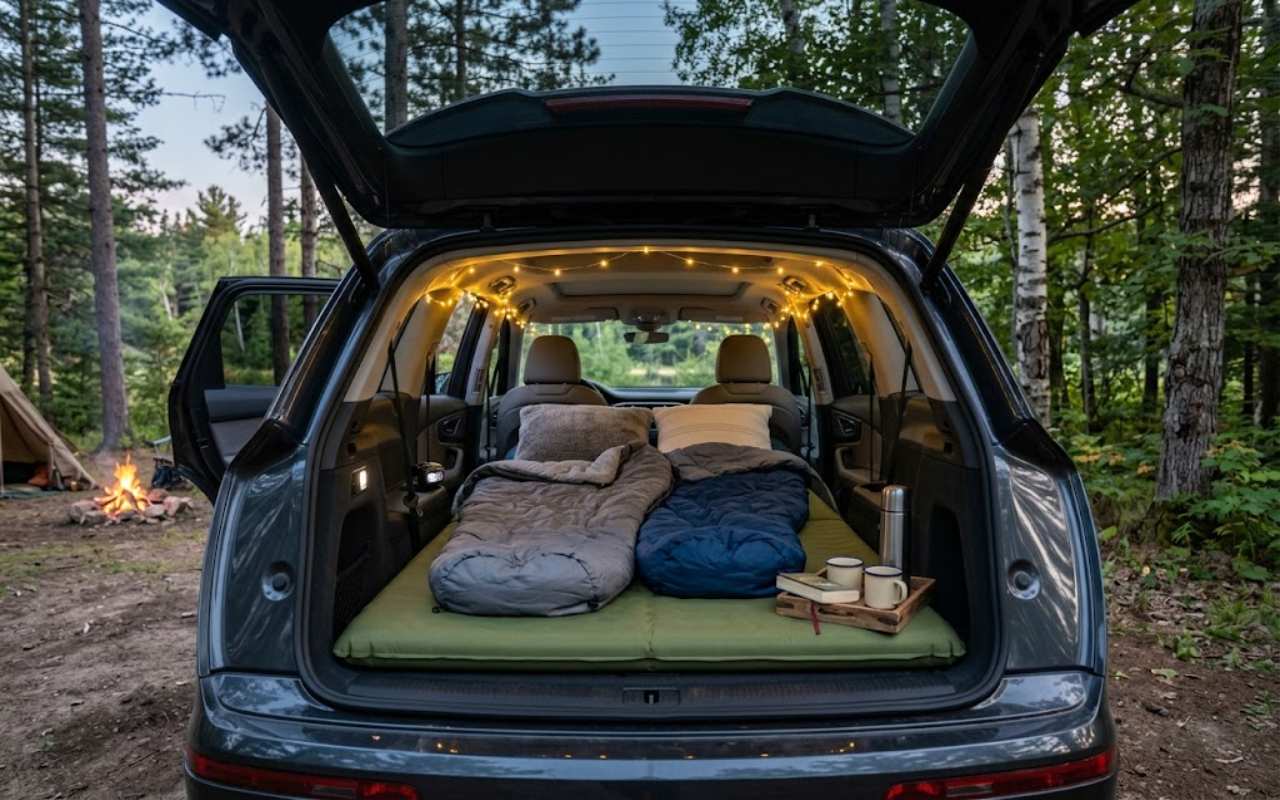
Utilizing a premium electric crossover platform for vehicle-based remote travel introduces a highly advanced method of off-grid exploration.
Unlike traditional internal combustion engines that rely on static mechanical idling or standalone portable lithium battery stations, the electric vehicle platform leverages its primary high-voltage propulsion architecture to maintain full cabin conditioning.
This guide analyzes the exact mechanics behind tesla model y camp mode battery drain parameters, breaks down internal cargo clearances, and outlines an optimized strategy to configure the car’s dual lower storage wells.
Core Interior Dimensions and Spatial Constraints
Executing a viable sleeping configuration inside the all-electric cabin requires a strict understanding of structural boundaries. Because there are no internal mechanical driveshafts or exhaust heat shields beneath the rear floorboard lines, the Tesla Model Y maximizes vertical and horizontal layout boundaries differently than a standard combustion platform.
- Linear Sleeping Clearance: While Tesla does not publish official multi-row folded floor lengths, third-party physical laser measurements from overlanding gear manufacturers peg the maximum usable horizontal reach at roughly 78.7 inches (200 cm). This tracks from the closed inner liftgate panel straight forward to the back of the front seats when slid fully forward on their tracking frames.
- Lateral Wheel-Well Bottleneck: 37.0 inches (94 cm) of clear width is available at the narrowest point of the cargo floorpan, localized directly between the rear plastic wheel-arch wells.
- Main Cabin Shoulder and Hip Constraints: Data from the official Tesla Model Y Owner’s Manual outlines a tapering cabin width. The front row boasts 56.4 inches of shoulder room, which narrows to 53.2 inches of second-row shoulder room. However, operators should note that the ultimate baseline mattress constraint is defined by a tighter, official 50.5-inch second-row hip-room restriction near the floor cushion base.
- Vertical Threshold Height: Physical dimension mapping of the rear liftgate metal frame line reveals a maximum vertical opening height of 27.6 inches (70 cm), establishing a strict upper boundary for loading rigid gear or thick mattress setups.
The Hourglass Mattress Constraint
Because the vehicle interior narrows sharply to exactly 37.0 inches between the wheel wells but widens to 54.6 inches at the doors, standard rectangular mattresses fail to maximize the space. Forcing a rigid rectangular pad into this space stresses the soft side trim panels.
To utilize the cabin properly, custom-fit setups must feature a specialized tapered layout contoured to hug the 37.0-inch bottleneck while expanding into the 54.6-inch shoulder zone without stressing the side door panels or fabric upholstery, similar to the tailored geometry found on the official Tesla Shop mattress module.
Analyzing Camp Mode Power Consumption Physics
The defining advantage of electric overlanding is the integrated factory climate regulation framework. Activating the system via the climate control panel engages a dedicated climate loop that maintains constant fresh airflow, regulates target cabin temperatures, runs interior accessory ports, and leaves the central touchscreen fully live overnight.
Managing energy allocation requires understanding the real-world depletion curves of the vehicle battery array:
- Baseline Consumption Metrics: Under baseline temperate operating conditions ranging from 15 to 22 degrees Celsius, the system draws a highly predictable 1 percent of battery capacity per hour. Over a standard 8-hour sleeping cycle, this results in an aggregate depletion rate of roughly 8 percent to 10 percent of your overall energy storage.
- Extreme Thermal Load Variability: Because the system operates using an integrated high-efficiency heat pump architecture, ambient outdoor temperatures heavily dictate final consumption curves. In sub-zero winter environments or extreme summer heatwaves exceeding 35 degrees Celsius, the climate compressor must work significantly harder to maintain the cabin equilibrium. This increased load accelerates the consumption matrix, causing an overnight energy drain variance ranging from 1.5 percent to 2.0 percent per hour, or up to 16 percent total over a full night.
- The System Lockout Guardrail: The vehicle firmware includes a built-in safety lockout protocol. If the vehicle main propulsion battery falls to exactly 20 percent state of charge, the vehicle automatically deactivates the climate loop to preserve the remaining energy for driving range, turning off all internal accessory lines.
Optimizing the Sub-Trunk Storage Layers
The lack of an exhaust pipe framework allows the vehicle to feature a unique deep lower storage well beneath the primary cargo load floor board. Utilizing this dual-depth space correctly is the secret to maintaining a completely flat sleeping surface while packing gear efficiently.
However, note that these configurations apply specifically to the standard 5-seater platform layout. If your vehicle is equipped with the optional 7-seater layout, the mechanical brackets and structural framework for the third-row seats fold directly down into this rear cavity, significantly reducing the deep sub-trunk well clearance dimensions.
1. The Primary Deep Well Layout
The lowermost trunk cavity features an aggressive drop-down depth. On standard 5-seater variants, this space is highly optimized for storing heavy travel accessories that are not needed inside the main cabin area overnight, such as charging cables, portable kitchen utensils, or compact 12V travel refrigerators.
Storing heavy items deep inside this well lowers your overall center of gravity while keeping your main upper sleeping area 100 percent free of gear clutter.
2. The Secondary Shallow Tray Matrix
Directly above the deep well sits a secondary shallow storage liner tray. This area acts as a quick-access hub for small personal electronic devices, headlamps, and thermal window panels. Because it rests right beneath the edge of the sleeping pad outline, items can be easily grabbed or put away during the night without disturbing your overall bedding alignment.
Technical Layout Engineering Blueprints
While general interior measurements provide a reliable baseline for basic car-camping setups, minor layout variances occur across specific platform manufacturing years.
Internal sub-floor framing shapes, seat-fold mechanical hinge heights, and localized vertical headroom metrics differ slightly depending on whether the vehicle is a standard long range configuration or a multi-motor performance variant featuring specialized structural tuning elements.
For operators seeking exact, high-fidelity dimension mapping tailored directly to these specific vehicle lines, we provide an exhaustive, vehicle-specific breakdown.
The independent Tesla Model Y SUV Camping Blueprint delivers a complete 8-page field guide, including precise structural millimeter clearances for all model variants, secure overnight airflow ventilation dimensions, advanced touch screen power configuration overrides, and comprehensive component mapping.

Written by Enzo S.
Enzo is an outdoor enthusiast with over 12 years of hands-on vehicle overland and car-camping experience. He specializes in testing interior cargo setups, calculating vertical space limitations, and crowdsourcing verified platform build data across active enthusiast networks to provide practical, completely bias-free gear solutions.