Affiliate Disclosure: As an Amazon Associate, I earn from qualifying purchases. If you purchase through our links, we may earn a small commission at no extra cost to you.
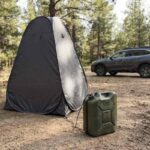
To build a leak-proof car camping grey water system that complies with land regulations, capture dishwater in a collapsible catch basin, strain out all food solids, and transfer the runoff into a rigid 2.5-gallon HDPE 2 jerry can treated with mineral powder. Because stagnant grey water biologically turns septic within 24 to 48 hours inside hot vehicle cabins, storing runoff in a rigid, gasket-sealed container prevents trunk carpet leaks and ensures safe disposal at RV dump stations or municipal flush toilets.
Learning how to dispose of grey water when car camping requires solving two distinct challenges: navigating complex federal land regulations and containing soapy, bacteria-prone runoff inside a hot, unvented vehicle cabin.
Unlike full-size RVs equipped with under-chassis holding tanks and exterior roof vents, campers in mid-size SUVs like the Toyota RAV4, Subaru Outback, or Honda CR-V must store and transport dishwater directly alongside their sleeping gear.
Whether you are boondocking on public lands or stealth camping in urban zones, this engineering and legal guide breaks down exact container dimensions, chemical odor control, and compliant disposal rules.
Public Land Enforcement & The “Wash Water” Loophole
Many car campers assume that pouring a small basin of dishwater onto the dirt at a dispersed campsite is universally allowed. In reality, ranger enforcement varies sharply by jurisdiction, and misinterpreting the rulebook leads to steep fines.
Federal Regulations vs. State Reclassifications
- The Federal Baseline: Under federal regulation 43 CFR 8365.1-1(b)(3), draining sewage or dumping refuse from a vehicle on Bureau of Land Management (BLM) land is strictly prohibited, with a narrow exception carved out for “wash water” except where receptacles are provided.
- The Supplemental Rule Trap: Local BLM and U.S. Forest Service field offices routinely override this baseline exception by issuing strict Supplemental Rules for high-traffic corridors, banning all ground discharges regardless of water type.
- The Kitchen Sink Classification: State environmental codes draw sharp lines between bathing water and dishwater. Under Arizona Department of Environmental Quality rules (A.A.C. R18-9-711), wastewater from showers and bathroom sinks is legally defined as gray water, whereas water from kitchen sinks and dishwashers is excluded and regulated strictly as sewage.
Overlander Field Observations
Field reports across overlanding communities highlight an inconsistent enforcement landscape on public lands. Campers frequently note that rangers within the same district interpret the rules differently, with some permitting uncontained shower runoff while strictly ticketing anyone draining water containing food particles.
To avoid citations, never drain wash water at a developed campground, near a shared fresh-water spigot, or onto any paved surface. Always verify local field office supplemental rules before dispersing water on public land.
The “Biodegradable Soap” Myth in Water-Adjacent Camping
A widespread misconception among novice campers is that buying “biodegradable” or “camp-safe” soap makes it legal and safe to dump grey water directly into rivers, lakes, or dry washes.
The Biology of Soap Breakdown
- Zero Aquatic Breakdown: Biodegradable camp soaps do not biodegrade in water. Surfactants require active contact with aerobic soil bacteria to break down safely.
- Ecosystem Toxicity: Introducing even small amounts of eco-friendly soap into a lake or stream lowers surface tension, strips protective mucus from fish gills, and triggers harmful algae blooms.
- The 200-Foot Hard Rule: Because soil microbes are mandatory for decomposition, the Leave No Trace Center for Outdoor Ethics and land agencies enforce a strict 200-foot (70 adult paces) buffer zone from all water sources, dry washes, and trailheads.
Proper Backcountry Dispersal Protocol
If you are in a remote backcountry zone where surface dispersal is explicitly permitted:
- Strain Every Drop: Pour your wash water through a fine-mesh strainer first to catch all food particles, packing those solids out in your sealed trash bag.
- Broadcast Wide: Walk at least 200 feet away from any water source and scatter the strained water widely over absorbent soil or pine needles—never dump it in a single concentrated puddle.
Grey Water Catch Basins: Collapsible Tubs vs. Portable Sinks
Before you can store or dispose of grey water, you need an efficient way to capture it while washing dishes or brushing your teeth at camp.
Choosing the Right Catch Basin
- Collapsible Silicone Wash Tubs: Models with integrated drain plugs (typically measuring 12″ x 12″ x 8″ expanded and folding down to 2 inches flat) fit easily behind an SUV passenger seat. Look for units with rigid polypropylene rims that will not buckle when lifted full of water.
- Rigid Dishpans: Standard 12-quart plastic dishpans offer superior structural stability on uneven picnic tables or tailgates and double as dry gear organizers during transit.
- Built-In Drain Strainers: Always pair your catch basin with a removable silicone sink strainer basket to trap rice, oils, and food scraps before transferring the water into your storage jug.
Leak-Proof SUV Storage: Why Collapsible Bladders Fail
Because cargo space is tight in mid-size SUVs, many campers buy folding, collapsible plastic water bladders to store their grey water. In vehicle-interior testing, thin flexible bags prove to be a major liability.
The Mechanics of Corner Fatigue
- Crease Stress: Collapsible bladders rely on thin, flexible low-density polyethylene (LDPE) or PVC films. Every time the bag is folded flat for storage, sharp creases form at the corners.
- Pinhole Leaks: These folded corners fatigue rapidly under road vibration, developing microscopic pinhole leaks that allow soapy, bacteria-laden water to soak into porous trunk carpeting and spare tire wells.
Proven Rigid Storage Hardware & Exact Dimensions
To eliminate leaks inside your cargo bay, store grey water exclusively in thick-walled, rigid containers sized for SUV footwells and cargo wells:
- Scepter 2.5-Gallon Rigid HDPE 2 Jerry Can: Measuring 13.6″ L x 6.6″ W x 11.8″ H, this High-Density Polyethylene jug weighs 20.8 lbs full of water (plus ~2.5 lbs empty container weight). Its narrow 6.6-inch width slides easily into a Subaru Outback or Toyota RAV4 rear footwell without tipping, and its coarse-threaded cap with a rubber O-ring gasket prevents spills on rough trails.
- YOSN 5-Gallon Camping Water Jug with Spigot: For larger basecamp capacity, a rigid 5-gallon polyethylene container holds 41.7 lbs of water (weighing 43.9 lbs total including its 2.2-lb empty frame). While its dual ergonomic handles and 3.6-inch wide mouth make it easy to scrub out interior biofilm, lifting and pouring a 44-pound jug into a public restroom toilet without splashing is difficult inside tight stalls.
- PAK Premium 16 Quart Oil Drain Pan: A widely used overlanding workaround is repurposing a brand-new, rigid 16-quart (4-gallon) high-density polyethylene automotive drain container measuring roughly 20″ L x 17″ W x 6″ H and holding 33.4 lbs of water. Its low 6-inch profile slides flat beneath wide SUV sleeping platforms, while its tethered sealing cap, easy-grab handles, and angled pouring neck prevent transit leaks.
Cabin Fermentation: Stopping the Septic Odor Loop
Unlike an RV where the grey tank is mounted beneath the floor and vented through the roof, a car camper stores runoff inside a sealed, unvented cabin. When an SUV sits parked in the sun, interior temperatures easily exceed 100°F (38°C), turning your grey water jug into a biological incubator.
The Chemistry of Cabin Stench
- Rapid Anaerobic Bloom: Tiny traces of food grease, skin oils, and soap scum feed anaerobic bacteria. Within 24 to 48 hours in a warm vehicle, stagnant grey water biologically turns septic, producing hydrogen sulfide gas that smells identical to raw sewage.
- The “Empty Jug” Odor Trap: Even traveling with an empty unwashed grey container produces an acrid stench by late afternoon due to residual biofilm coating the inside plastic walls.
Tank Treatment Chemistry in Hot Cars
To stop bacterial fermentation inside a hot SUV, choosing the right tank treatment is critical:
- Mineral-Based Powders (Best for Extreme Heat): Products like Happy Campers use a mineral-based micronutrient formula rather than delicate live enzymes. Because standard biological enzymes break down and lose effectiveness in extreme heat above 87°F (31°C), mineral powders remain reliable inside sun-baked car cabins.
- Resilient Spore & Enzyme Treatments: While traditional liquid enzyme cleaners lose potency in high cabin heat, spore-forming bacterial digestors like Unique RV Digest-It and enzymatic pods like Walex Bio-Pak break down grease effectively across wider temperature swings. Alternatively, non-enzyme citrus formulas like Camco TST MAX mask odors chemically without relying on live cultures.
- Pre-Wipe & Daily Dump Rule: Always wipe plates clean with a paper towel before washing to keep oils out of your jug, pre-dose your empty jug with treatment before adding water, and empty the container within 24 hours.
Grey Water Storage & Disposal Comparison Matrix
Use this comparison matrix to match your vehicle layout and camping environment with the safest, legally compliant storage and disposal method.
| Storage & Disposal Method | Legal Compliance Risk | Cabin Odor & Leak Risk | Best Vehicle Application |
|---|---|---|---|
| 2.5-Gal Rigid HDPE 2 Jug + Dump Station | Zero (100% legal in cities, parks, and BLM lands) | Low (Rigid walls prevent leaks; mineral powder stops heat odors) | All SUVs, crossovers, and urban stealth rigs (RAV4, Outback, CR-V) |
| Strained 200-Foot Backcountry Scatter | Moderate (Legal only where BLM/Forest rules allow) | None (Water is dispersed immediately after washing) | Remote dispersed camping away from waterways and campgrounds |
| Repurposed 4-Gal Oil Drain Container | Zero (100% legal when emptied at RV dump stations or toilets) | Low (Low 6.25″ flat design prevents tipping in cargo bays) | SUVs with wide cargo decks or under-platform storage drawers |
| Collapsible Folding Water Bladder | Low (Compliant if emptied at proper dump stations) | Severe (Folded corners split and leak into trunk carpets) | Not recommended for inside-vehicle cabin transport |
Urban Stealth Disposal: Legal Realities vs. City Hacks
For urban car campers, getting rid of grey water without drawing attention is a major logistical hurdle.
Why Street Drains Are Off-Limits
Dumping soapy water into a municipal street storm drain is illegal in virtually every city. Unlike indoor sink drains that route to a wastewater treatment plant, street storm drains flow directly—untreated—into local rivers, lakes, and watersheds. Dumping visible puddles on asphalt is also the fastest way to have security or law enforcement called on your vehicle.
Safe Urban Extraction Methods
- The Restroom Toilet Transfer: The cleanest, 100% legal method for urban campers is transferring strained grey water into a dark, opaque 1-gallon jug (such as an empty laundry detergent bottle), carrying it inside a backpack into a public restroom or highway rest stop, and flushing it down a standard toilet.
- RV Dump Stations & Coin Car Washes: Use apps like iOverlander or Sanidumps to locate free municipal RV dump stations, or empty your rigid jug into the floor drain bay at a self-serve coin car wash (where floor drains route directly to sanitary sewer treatment systems).
Car Camping Grey Water FAQ
Can I dump grey water in a campground vault toilet or pit toilet?
No. Vault toilets and pit toilets are engineered specifically to hold low-volume human waste and break it down naturally or hold it for pump trucks. Pouring gallons of soapy grey water into a vault toilet fills the tank prematurely, disrupts the biological breakdown balance, and violates campground rules. Always use designated utility sinks or RV dump stations.
Is it legal to dump grey water on the ground if I only use water with no soap?
It depends on what you washed. Plain water used only to rinse clean hands or boil pasta (strained of starch) is generally tolerated in dispersed backcountry areas 200 feet from water. However, water containing food grease, meat juices, or toothpaste attracts wildlife (including bears and rodents) to your campsite and is strictly prohibited in developed campgrounds and national parks.
How do I clean a grey water jug that already smells like sewage?
Use a dilute bleach soak. Fill the rigid HDPE 2 jug with warm water and add 1/4 cup of unscented household bleach. Shake thoroughly, let it sit for 2 hours to kill the anaerobic biofilm coating the plastic walls, drain it into a household toilet, and rinse thoroughly with fresh water before storing.
Mastering Clean Water Logistics on the Trail
Managing grey water inside an SUV comes down to treating soapy runoff with the exact same care as solid waste. To keep your vehicle odor-free and avoid heavy ranger fines, follow these three core rules:
- Use Rigid, Right-Sized Containers: Store runoff in a 2.5-gallon Scepter HDPE 2 jerry can (13.6″ x 6.6″ x 11.8″, 20.8 lbs full) or a low-profile PAK Premium 16-quart drain pan (20″ L x 17″ W x 6″ H) to prevent trunk carpet leaks and back strain.
- Respect the 200-Foot Buffer: Never assume biodegradable soap is safe near lakes or streams; strain all food solids and scatter water widely over dry soil only where explicitly permitted.
- Treat Against Cabin Heat: Pre-dose your storage jug with heat-stable mineral powder rather than standard liquid enzymes, and empty it into a flush toilet or RV dump station within 24 hours.

Written by Enzo S.
Enzo is an outdoor enthusiast with over 12 years of hands-on vehicle overland and car-camping experience. He specializes in testing interior cargo setups, calculating vertical space limitations, and crowdsourcing verified platform build data across active enthusiast networks to provide practical, completely bias-free gear solutions.