Affiliate Disclosure: As an Amazon Associate, I earn from qualifying purchases. If you purchase through our links, we may earn a small commission at no extra cost to you.
Why Do Car Window Screens Leak in the Rain?
Car window screens can leak when wet mesh touches the door frame or interferes with weather seals. Wind-driven rain and poor screen placement can also let water inside. A properly fitted, free-hanging mesh screen and compatible exterior rain deflectors may help reduce leaks.
Sleeping in the back of an SUV during a heavy downpour transforms your vehicle into a resonant acoustic chamber and a highly efficient humidity trap. While a steel vehicle body provides absolute protection from wind and driving rain, it possesses zero natural ability to manage internal vapor pressure, fluid tracking, or localized water ingress.
Surviving a multi-day storm comfortably requires an exact understanding of automotive fluid dynamics, capillary action, and cabin thermodynamics to keep your sleeping platform bone-dry.
This technical guide bypasses generic camping platitudes to deliver field-tested structural blueprints and moisture-mitigation strategies. Culled from overlander trail tests, mechanical safety baselines, and real-world forum build iterations, here is how to weatherproof your vehicle sleep system against severe wet weather.
The Capillary Action Trap: Why Fabric Window Socks Fail in the Rain
A common mistake documented across overlanding trail tests is relying on slip-over fabric mesh door “socks” for ventilation during a rainstorm. While these budget-friendly additions are excellent for summer insect exclusion and privacy in dry conditions, deploying them during active rainfall introduces a direct path for structural water damage.
The Physics of Fluid Wicking
The core failure mechanism of the fabric window sock is capillary action—the ability of a liquid to flow through narrow spaces without the assistance of, or even in opposition to, external forces like gravity.
- The Process: When rain hits the exterior layer of the porous fabric mesh, the water molecules bind to the synthetic fibers. Because the sock tightly wraps around the entire upper door frame, the fabric maintains continuous physical contact with both the exterior steel chassis and the interior door card fabric.
- The Ingress: Capillary pressure pulls water straight through the mesh, bridging the vehicle’s rubber weather-stripping seals. Once inside, the water saturates the interior fabric door panel, drips down into the window switches, and pools under your foam mattress.
Capillary Ingress Failure Analysis
How porous fabric window socks siphon storm moisture past rubber seals
Community Observations and Weatherproof Alternatives
Long-term vehicle sleepers treat window socks strictly as “bug-only” dry-weather gear. When a storm rolls in, overlander field tests recommend replacing the sleeve method with a zero-tension separation barrier:
- The Magnetically Suspended Screen: Cut a custom sheet of no-see-um mosquito netting slightly larger than your window frame. Use rubber-coated, high-pull rare-earth magnets to clamp the netting to the outer sheet metal underneath an installed hard plastic window rain deflector (vent visor). Because the netting hangs freely and is not stretched around the interior frame door lip, it cannot act as a capillary siphon.
- The Interior Insect Bivy Backstop: For sudden squalls where setting up external netting is unviable, community members utilize a bivy-style mosquito net worn directly over the sleeping bag inside a fully buttoned-up cabin.
How to Prevent SUV Condensation While Car Camping
One of the most dangerous and counterintuitive realities of sleeping in a vehicle during wet weather is that sealing the cabin completely airtight to shut out rain actually makes the interior wetter. An adult human exhales roughly 0.2 to 0.5 liters of water vapor overnight. In a cold, sealed SUV cabin, this humidity behaves predictably according to the laws of thermodynamics.
The Mechanics of Internal Humidity
When hot, moisture-laden breath hits glass windows and cold sheet metal, the air rapidly drops below its dew point. The water vapor undergoes an instant phase change, transforming into heavy liquid condensation that covers the headliner and window glass.
Within hours, this high relative humidity destroys the loft of down or synthetic sleeping bags, completely compromising their insulation capability. Worse, in urban car living environments, heavy window fogging instantly destroys your stealth profile, creating a dead giveaway to police or security guards that a human is sleeping inside.
Condensation Management Checklist
Active protocol to exhaust internal humidity and prevent interior frost loops
The “Deflector + Opposite Crack + Fan” Airflow Stack
To maintain equilibrium inside the cabin, you must establish an active cross-ventilation system that exhausts vapor pressure before it can condense.
- Opposing Air Gaps: Install high-quality window rain deflectors on all four doors. We highly recommend using a model-specific set like the Auto Ventshade (AVS) Smoke Window Vent Visors, which are built from impact-resistant molded acrylic. These outside-mount or in-channel rain deflectors allow you to crack at least two opposite windows (e.g., driver front and passenger rear) by one to two centimeters. The visors prevent vertical rain from dropping inside, while the opposing gaps create a natural low-pressure draft to pull fresh air through.
- Mechanical Vapor Clearance: Position a quiet, high-capacity brushless fan near one of the open window gaps, orienting it to actively sweep air outward. We highly recommend utilizing the Koonie 8-Inch Rechargeable Battery Powered Clip-on Fan. Its heavy-duty 10000mAh battery pack guarantees multiple nights of continuous runtime, while the rugged built-in clamp lets you anchor the fan directly to overhead grab handles or headrest posts to break up humid boundary air pockets.
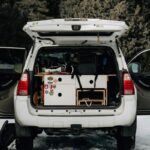
- The “Drape and Close” Hatch Trick: In severe, sideways-driving rain where door windows must remain shut, trail tests confirm the efficacy of cracking the rear liftgate using a 4×4 timber block cut diagonally as a solid mechanical hatch prop. Drape a sheet of no-see-um mesh over the trunk rim and close the hatch onto it; the factory weather stripping grips the mesh securely, using the natural overhang of the rear hatch as an awning to allow massive air exchange without water penetration.
Quarantining the Wet Zone: Preventing Platform Fluid Transfer
Tracking mud, saturated rain jackets, and dripping boots into your main living and sleeping quarters is the fastest way to ruin an overlanding trip. Once wood platforms, memory foam toppers, or blankets absorb organic ground moisture, they become breeding grounds for mold and mildew that are near impossible to dry out in a wet environment.
Constructing a Functional Vehicle Mudroom
Seasoned car camping logs emphasize treating the front sections of the SUV cabin as a dedicated exterior airlock or mudroom. Because the front footwells are completely isolated from the flat rear cargo bed by the center console and front seats, they serve as the perfect physical quarantine area.
- The Front Footwell Vault: Line your driver and passenger floorboards with deep-channeled, heavy-duty rubber floor liners (such as WeatherTech mats). When entering the vehicle through the side doors during a downpour, drop your wet footwear directly onto these mats. They hold cups of standing water safely away from the underlying factory cabin carpet and can be wiped clean with a single rag.
- The Dedicated Lidded Storage Bin: For completely soaked rain jackets, muddy tarps, or umbrellas, place a rugged, lidded plastic storage tote like the Rubbermaid ActionPacker 24-Gallon Lockable Storage Box right in the front passenger seat or footwell. Sealing your wet technical outer layers inside this heavy-duty, weather-resistant plastic container restricts ambient evaporative moisture from escaping back into the cabin air volume, protecting your rear bedding from secondary humidity spikes.
Cabin Moisture Isolation Plan
Spatial layout to quarantine wet outer gear away from sleeping areas
The “Lid-On, Outside-The-Car” Footwear Strategy
A highly advanced community workaround used during stagnant downpours is the exterior-ground storage technique. If your vehicle is equipped with a large rear liftgate that opens upward, the extended door functions as a temporary roof canopy.
Before climbing into your sleeping bag, place your wet boots inside your heavy-duty Rubbermaid ActionPacker, lock the latches securely, and place the plastic box on the ground directly underneath the dry overhang of the open rear hatch.
Climb into the sleeping area, pull the hatch down to its propped ventilation lock position, and close the car. This strategy keeps 100% of your footwear’s evaporative humidity load completely outside the cabin footprint overnight while keeping your boots safe from the elements.
Hardware Optimization: Heavy-Duty Rain-Camping Gear Selection
To construct a high-ranking, weather-insulated SUV sleep setup, look beyond generic sleeping gear and analyze tools engineered to manage ambient moisture and structural constraints during extended storms.
| Equipment Component | Material Choice | Technical Specifications / Path | Primary Purpose |
|---|---|---|---|
| Window Protection | Auto Ventshade (AVS) Smoke Window Vent Visors | Impact-resistant molded acrylic; outside-mount or in-channel design options. | Permits reliable cabin ventilation during heavy downpours without letting vertical water entry bypass the door frame. |
| Acoustic Isolation | Mack’s Ultra Soft Foam Earplugs (50-Pair Jar) | NRR (Noise Reduction Rating) \(\ge \) 32dB; slow-recovery polyurethane. | Dampens the deafening drum effect of rain hitting thin sheet-metal roofs to allow restful sleep. |
| Hatch Prop & Chock | Diagonally Split 4×4 Lumber | Kiln-dried Douglas Fir; treated waterproof coating. | Serves a dual-purpose role as a heavy-duty rain-shedding hatch wedge or a solid tire chock. |
| Gear Relocation | MeeFar 15 Cubic Feet Waterproof Cargo Bag | 100% waterproof 700D PVC tarpaulin; includes anti-slip mat, 6 security hooks, and combination luggage lock. | Migrates dry duffel bags, camping chairs, and storage items entirely out of the internal cabin to maximize human vertical headroom inside the SUV during a heavy storm. |
| Anti-Condensation Deck Underlay | Queen Size 3D Air Mesh Mattress Underlay Ventilation Pad | Premium polypropylene material; triple-layer ventilated air-core matrix. | Rests directly between your SUV platform and mattress cushions to establish a permanent open channel for cross-ventilation, stopping base moisture. |
| Breathable Base Padding | DMI Egg Crate Open-Cell Foam Pad | Convoluted open-cell polyurethane foam; high permeability peak-and-valley grid. | Acts as a budget-friendly cushion break that breathes under pressure, letting fresh air channel beneath memory foam layers to disrupt interstitial moisture trapping. |
Structural Maintenance: Checking the Hatch Water Traps
Long before you head out into a storm, you must audit your SUV for hidden factory water paths. Rain does not just enter through open windows; a vehicle has multiple factory body seams that can degrade over time and turn into major internal leak traps.
Investigating the Third Brake Light Gasket
A major finding documented across vehicle-specific forum threads (particularly on platforms like the Subaru Outback and Honda CR-V) is that water pooling in the rear trunk area is rarely caused by a bad hatch door seal. Instead, the primary culprit is almost always a degraded factory gasket behind the top-center third brake light assembly.
Over time, UV exposure and heat cause this foam seal to shrink and crack. When rain runs down the roof line, it flows directly behind the plastic light housing, fills the inner structural cavities of the liftgate, and exits as a literal waterfall out of the recessed trunk handle or interior ceiling panels the moment you tilt the hatch open.
Weep-Hole Gasket Repair Sequence
Step-by-step engineering fix for leaky third brake light housings
The Weep-Hole Alignment Fix
When executing this community-proven repair using silicone or exterior butyl tape, builders must maintain a specific seal orientation. Apply your sealant along the top edge and both side borders of the brake light housing, but deliberately leave a tiny 5-millimeter gap at the absolute bottom center.
If you seal the entire perimeter completely airtight, any residual water that migrates past the trim will become permanently trapped in the housing, eventually forcing its way past the interior electrical wiring.
Leaving the bottom edge open acts as an engineered weep hole—ensuring that gravity naturally drains moisture down the exterior window glass rather than channeling it into your rear sleeping quarters.
Master Your Next Rainy Overlanding Adventure
Weatherproofing your SUV sleep environment means working with vehicle physics rather than fighting them. By eliminating fabric siphons, establishing active cross-ventilation, and isolating wet technical outerwear in dedicated plastic storage bins, you can comfortably ride out multi-day storms without compromising your gear or your health.
The Ultimate Quick-Start Rain Checklist:
- The Ventilation Base: Clip your Koonie 8-Inch Fan to an overhead post and crack opposing windows under your BriYorWay Rain Guards.
- The Insect Screen: Hang your Skeeta 40-Denier Netting using rubber-coated N52 Block Magnets.
- The Core Quarantine: Drop muddy hiking boots inside your heavy-duty Rubbermaid ActionPacker and place it under the dry hatch overhang.
- The Bottom Airflow Matrix: Place your 3D Air Mesh Ventilation Pad directly over a DMI Egg Crate Foam Topper to keep bottom moisture from rotting your mattress.
Pack the right hardware, respect your vehicle’s fluid dynamics, and enjoy the calming sound of the storm outside.

Written by Enzo S.
Enzo is an outdoor enthusiast with over 12 years of hands-on vehicle overland and car-camping experience. He specializes in testing interior cargo setups, calculating vertical space limitations, and crowdsourcing verified platform build data across active enthusiast networks to provide practical, completely bias-free gear solutions.