Affiliate Disclosure: As an Amazon Associate, I earn from qualifying purchases. If you purchase through our links, we may earn a small commission at no extra cost to you.
This fitment dossier was built by crowdsourcing real-world setup logs, generation-specific trunk measurements, and interior layout debates from dedicated Tesla owner forums and wilderness trail networks. Finding the right camping mattress for your Honda CR-V or Tesla crossover requires throwing away legacy internal combustion rules and designing around a high-voltage battery platform.
Optimizing the Tesla Model Y for overnight stays is an exercise in managing an ultra-narrow wheel arch bottleneck, countering sub-floor cover plate flexing, and programming automated climate control limits. To build a highly efficient mobile cabin, you must design your sleep layout around exact interior boundaries, high-voltage parasitic draws, and vehicle-specific geometry.
Technical Fitment Matrix: Top Tesla Model Y Mattress Configurations


The 37-Inch Wheel Arch Bottleneck: Navigating Inward Sloping Plastic
The primary layout constraint inside a Tesla Model Y is the aggressive, inward-sloping architecture of the rear plastic trunk side panel trim covers. Community overlander tests on Tesla forums highlight that while the mid-cabin door span offers a spacious 51.5 inches of horizontal shoulder room, the hard choke point between the rear wheel wells narrows down to a tight 37.5 to 38.0 inches of clear horizontal width.
This ultra-narrow boundary means that standard residential Twin mattresses (38 inches wide) or traditional boxy camping trifolds will squeeze, bunch, and deform violently at the base. This lateral friction places immense stress on air seams and pushes the center of the bed upward, resulting in a cramped sleeping pocket.
- The Tapered Geometry Selection: Trail tests emphasize utilizing a mattress explicitly engineered with a contoured, tapered profile. The foot-end of the mattress must taper down to 36 or 37 inches wide to drop completely flat between the plastic wheel arches without buckling.
- The Front-Row Headrest Void Extension: Sliding the driver and passenger seats fully forward against the dashboard unlocks a massive 74.5 inches of usable linear sleeping length from the rear liftgate latch to the front center console.
- The Structural Void Sag Flaw: Because premium open-cell hybrid layouts like the Exped MegaMat lack a rigid internal structural core or built-in extension panels at the head-end, they will sag drastically down into the 12-inch empty gap behind the front seats under human upper-body weight. To safely bridge this headrest void, community overlanders must utilize a dedicated rigid headrest extender panel or an inflatable footwell wedge to keep the sleeping horizon level.
Camp Mode Logistics: High-Voltage Battery Power Management
One of the greatest advantages of camping inside a Tesla Model Y is utilizing the factory’s automated “Camp Mode” settings configuration. This system keeps the vehicle’s high-voltage HVAC climate control system active, regulates internal cabin airflow, and maintains live power to all internal USB-C ports all night without the carbon monoxide risks of an idling gas engine. However, maximizing this utility requires managing specific energy consumption physics:
- The Parasitic HV HVAC Consumption Rate: Real-world overlander test logs confirm that running Camp Mode consumes between 1.0% to 1.5% of the Model Y’s high-voltage battery capacity per hour. In extreme freezing winter parameters or intense summer heat waves, this consumption can scale up to 2.0% per hour as the heat pump or air conditioning compressor fights ambient temperatures.
- The 20% Range Safety Threshold: Tesla’s factory battery management system features a hard-coded electronic safety lock. If your high-voltage vehicle battery drops to 20% state of charge (SoC), Camp Mode will automatically shut down instantly to preserve your driving range. Trail guides dictate arriving at your wilderness campsite with at least a 45% to 50% charge to ensure a safe, multi-day climate-controlled stay.
- The Panoramic Glass Roof Thermal Bleed: The massive factory panoramic glass roof functions as a severe thermal bridge. During winter camping, cold drafts rapidly radiate downward through the glass, forcing the vehicle’s heater to work harder and increasing battery drain. To mitigate this parasitic consumption, community trail tests rely on custom-cut reflective insulation window shades popped directly into the upper glass trim rails.
The Sub-Trunk Flexing Floor: Reinforcing the Storage Lid Ledge
Unlike traditional SUVs, the Model Y features a deep, sunken rear sub-trunk storage well directly beneath the main load floor deck. While this well is highly convenient for hiding heavy camping gear bins and food coolers out of sight, it introduces a structural support flaw when configured as a sleep surface:
- The Factory Cover Plate Flaw: The removable factory composite cover plate that seals the sub-trunk is engineered strictly for top-down cargo loading. When a human camper rests their knees, hips, or entire body weight directly over the rear section of the mattress, the concentrated weight causes the center of the composite board to flex, sag, or slide off its thin plastic support ledges.
- The Lateral Reinforcement Fix: Overlanders completely eliminate this collapsing risk without building a heavy wooden bed frame. Trail tests show that packing stiff, soft-sided duffel bags or a tightly fitted plastic storage container directly into the sub-trunk well until it matches the exact upper lip line creates a solid structural pillar.
- The Structural Foundation Alternative: This foundation cleanly catches the composite lid from beneath under human weight distribution loads, preventing any material buckling and keeping your sleeping horizon flat and unyielding.
Technical Fitment Matrix: Top Tesla Model Y Mattress Options
To guarantee a perfect fit, you must choose a mattress that fits within the Model Y’s strict 37.5-inch wheel arch width threshold and 74.5-inch linear length boundary. This chart tracks the best space-optimized options currently available on Amazon:
| Product Model | Architecture Type | Thickness | Weight | R-Value | Packed Size | Key Pros & Cons | Purchase Link |
|---|---|---|---|---|---|---|---|
| Tesla OEM Mattress | Hybrid High-Density Foam + Air Chamber | 3.12 Inches | ~13.5 lbs | Not Disclosed | 26″ x 10″ x 10″ | Pros: 100% precision contour tracking around wheel arches. Cons: 3-inch profile limits serious orthopedic padding compared to heavy foam. |
Shop Tesla Store |
| Exped MegaMat Duo 10 M | Self-Inflating Open-Cell Foam Hybrid (Medium) | 4.0 Inches | 7.28 lbs (7 lbs 4.4 oz) |
8.1 (ASTM) | 22.0″ x 11.0″ (Packed Tube) |
Pros: Pliable vertical sidewalls compress past wheel wells cleanly. Cons: Requires physical body-weight rolling compression to pack down. |
Shop on Amazon |
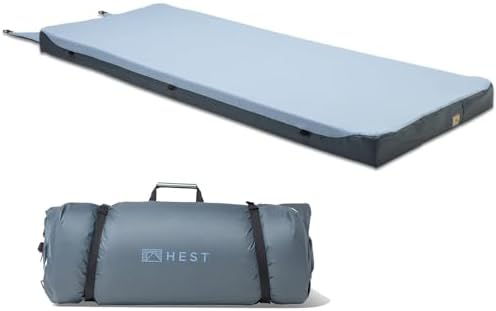
| HEST Foamy (Regular) | Dual-Layer Temperature-Resilient Memory Foam | 3.9 Inches | 11.0 lbs | 8.8 R-Value | 25″ x 12″ (Rolled Cylinder) |
Pros: Micro-cellular foam eliminates sub-zero crystallization. Cons: Solo 25″ width leaves half the trunk open but requires stable sub-floor alignment. |
Shop on Amazon |
| ROXGOX Twin Trifold | 2-Layer Gel Memory Foam & HD Base Blend | 6.0 Inches | ~21.5 lbs | Est. 1.5 – 2.2 | 38″ x 25″ x 18″ (Folded Cube) |
Pros: 6-inch orthopedic profile completely spans underlying seat hinges. Cons: Boxy 38″ width requires structural side squeezing between plastic panels. |
Shop on Amazon |
*Note: Home consumer tri-fold foam beds do not undergo standardized outdoor lab rating certifications under the ASTM F3340-18 layout. Uninsulated polyfoam variants provide a realistic estimated seasonal thermal resistance capacity equivalent of R-1.5 to R-2.2 under mobile vehicle configurations.
First-Party Innovation: The Tesla OEM Shop Alternative
Overland trail tests must also account for a major shift in the first-party EV gear landscape. Tesla officially introduced an OEM Model Y Air Mattress available on the Tesla Shop for $225.
This tailor-made product marks a departure from standard, basic inflatable bladders by utilizing a 3-inch high-density foam core layer nested inside the air chamber system, paired with a custom-molded 12V electric air inflation pump.
- The OEM Relevancy Verdict: This genuine factory layout fits the vehicle’s exact contours with 100% precision, completely dropping into the 37.5-inch rear wheel arches without any lateral bunching.
- The Aftermarket Trade-off: While the Tesla Shop configuration delivers exceptional edge-to-edge contour tracking, the 3-inch depth cannot compete with the massive 4-to-6-inch orthopedic density of a premium aftermarket hybrid or thick trifold mattress layout. For true sub-zero winter insulation barriers or serious long-term joint relief over a multi-day basecamp loop, upgrading to an all-weather open-cell system remains the standard for dedicated overlanders.
Final Verdict: Which Tesla Model Y Sleep System Wins?
Selecting your ultimate Tesla Model Y mattress configuration comes down to balancing your transit cargo storage bulk against your multi-camper spacing needs:
- The Absolute Best Overall Performance Setup: For double-occupancy overlanding comfort, the Exped MegaMat Duo 10 Medium dominates. Its flexible open-cell perimeter layout allows it to compress effortlessly past the narrow 37.5-inch rear wheel arches without bunching, while its high R-value breaks the glass-roof thermal bridge cleanly.
- The Best Long-Term Orthopedic Setup: If you manage lower back stiffness and want an unyielding, static base that completely removes internal hinge steps, deploying the ROXGOX Twin Trifold provides an exceptionally thick operating platform at an affordable cost, provided your sub-trunk floor lid is pre-reinforced.
- The Best Space-Saving Solo Choice: For solo EV explorers who want to minimize daytime transit packing volume, the HEST Foamy (Regular) is the prime selection. It slides cleanly down one side of the vehicle, leaving the other half of the cabin wide open for heavy refrigerators and portable power stations.

Written by Enzo S.
Enzo is an outdoor enthusiast with over 12 years of hands-on vehicle overland and car-camping experience. He specializes in testing interior cargo setups, calculating vertical space limitations, and crowdsourcing verified platform build data across active enthusiast networks to provide practical, completely bias-free gear solutions.