Affiliate Disclosure: As an Amazon Associate, I earn from qualifying purchases. If you purchase through our links, we may earn a small commission at no extra cost to you.
Yes, sleeping in your car at a highway rest stop is generally safe for short fatigue naps if you park on the passenger-car side near the main building, keep your engine off with a window cracked, and avoid isolated wooded pull-offs. While no federal law bans resting inside your vehicle at highway rest areas, individual state DOT time limits range from 2-hour caps to 24-hour stays, and parking in the semi-truck lane exposes your cabin to diesel exhaust fumes and tight trailer-swing hazards.
Pulling off a dark interstate at 2:00 AM leaves almost every road-tripper asking the same urgent question: is it safe to sleep in your car at a rest stop? The short answer comes down to three practical factors: where you position your vehicle in the lot, how you secure your doors and windows, and whether your state DOT enforces strict overnight time limits.
Fighting drowsy driving by pulling over is always safer than pushing through severe fatigue, yet unstaffed rural turnouts and commercial truck lanes introduce preventable hazards.
Drawing on highway safety physics, state Department of Transportation (DOT) guidelines, and road-tripper community observations across r/roadtrip, r/urbancarliving, and r/vandwellers, this guide breaks down the exact parking protocols, mechanical door-lock hacks, and legal rules you need before closing your eyes.
Quick Gear Picks: Essential Rest-Stop Sleep & Safety Gear
- Best Cabin Air Safety Monitor: First Alert CO400 Battery-Powered Carbon Monoxide Alarm (UL 2034 listed) runs on a standard 9V battery without needing a 120V wall outlet, providing reliable electrochemical carbon monoxide detection inside your cabin (Essential Safety Pick).
- Best Stealth Blackout Material: Reflectix 48-Inch x 10-Foot Reflective Insulation Roll cuts easily with household scissors to press-fit into SUV window frames, blocking interior light leaks and peeping eyes (Budget DIY Staple).
- Best Fresh-Air Condensation Guard: Auto Ventshade (AVS) Outside-Mount Rain Guards allow you to crack all four windows by one inch for cross-ventilation and moisture control without letting rain inside (Vehicle-Specific Upgrade).
Parking Lot Positioning: Why the Semi-Truck Lane Is a Hazard Zone
The biggest mistake road-trippers make at highway rest areas is pulling into the long pull-through spaces reserved for 18-wheelers. Community observations from professional truckers and long-distance travelers highlight two distinct physical risks when passenger cars park in commercial truck lanes.
Diesel Fumes, Reefer Noise, and Trailer Swing Geometry
- Diesel Exhaust & Reefer Emissions: Commercial semi-trucks frequently idle overnight to run cab climate control or refrigerated trailers (“reefers”). When a passenger SUV parks beside or downwind of an idling diesel rig, exhaust gases (including carbon monoxide and fine particulate matter) can seep through vehicle HVAC intake vents and cracked windows.
- Tight Lot Geometry & Trailer Swing: Truck parking lanes are engineered for wide turning radii, and professional drivers maneuvering 53-foot trailers in dark, tight lots have massive blind spots near ground level. A low-profile sedan or crossover parked in a commercial slot sits directly inside the off-tracking swing path of turning trailers, while also taking away federally scarce rest spaces from commercial drivers bound by Hours of Service laws.
Community-Derived Rest-Stop Positioning Rules
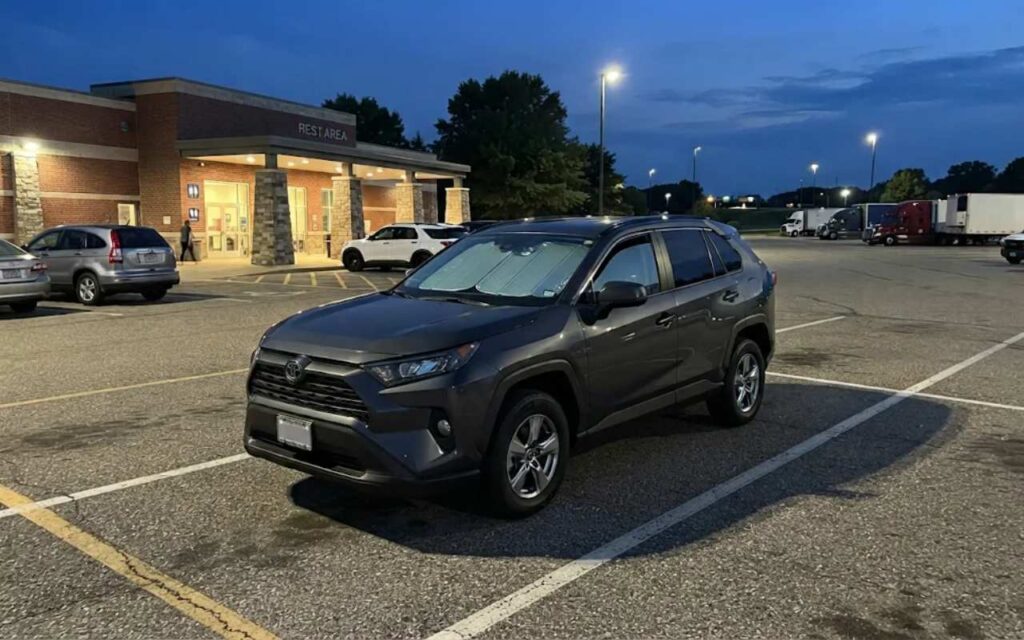
- Stay Strictly on the Passenger-Car Side: Always park in standard passenger vehicle stalls near the main restroom building and security cameras.
- Avoid the Brightest Overhead Pole: Position your car within sight of the main walkway lighting for deterrence, but avoid parking directly underneath a blinding LED floodlight that shines straight through windshield gaps.
- Stage for a Forward-Only Exit: Pull through a double stall or back into a space so you can drive straight out in seconds without shifting into reverse if someone approaches your vehicle unexpectedly.
Cabin Security & Stealth Hacks: Window Covers, Seatbelt Locks, and Ventilation
Sleeping inside a parked car requires balancing visual privacy against physical security and fresh airflow. Road-trippers and car-dwellers rely on three practical mechanical habits to prevent break-ins and cabin moisture buildup.
Pre-Staging Blackout Covers for Stealth
- The Peeping-Tom Dilemma: Community observations note that putting up shiny silver sunshades inside a crowded rest stop immediately advertises that someone is sleeping inside, which can draw curious onlookers or thieves.
- The Two-Stage Setup Routine: Experienced car campers install rear cargo and backseat window covers (such as custom-cut Reflectix or matte-black foam board) at a gas station or highway exit before arriving at their overnight rest area. Once parked for the night, you simply slip into the back and pop the front windshield shade into place in seconds without turning on dome lights. Just remember to remove all front-row coverings before pulling back onto the interstate to stay compliant with front-row car window screen obstruction laws.
The Seatbelt-Through-Door-Handle Lock
- How the Mechanical Trick Works: Long-haul drivers and van-lifers frequently loop the front seatbelts through the closed interior door grab handles before clicking the buckle into the latch, then pulling the belt all the way out to engage the automatic locking retractor (ALR) ratchet. Even if someone bypasses the electronic door lock from outside, the tensioned nylon webbing physically prevents the door from swinging open.
- Important Vehicle Fitment Caveat: This technique only works on vehicles equipped with closed-loop interior grab handles and ratcheting ALR seatbelts. It will not work on vehicles with flush, open-ended, or electronic push-button door releases, and you should always practice unbuckling the belt quickly in the dark so you can exit rapidly in an emergency.
Cracked-Window Ventilation & Carbon Monoxide Safety
- Preventing Condensation & CO Buildup: Sleeping inside a closed SUV releases roughly half a pint of moisture per person through respiration overnight, fogging every window and signaling an occupied vehicle. Cracking at least two opposite windows by half an inch to one inch (ideally shielded by Auto Ventshade (AVS) Outside-Mount Rain Guards) creates passive cross-ventilation without exposing your interior. See our full breakdown on managing SUV condensation and ventilation during rainstorms for multi-hour storm setups.
- Never Idle Your Engine While Sleeping: Never leave your vehicle’s engine running for heat or air conditioning while asleep, as an exhaust leak or snowbank blockage can quickly fill the cabin with lethal carbon monoxide. Keep a battery-powered First Alert CO400 Battery-Powered Carbon Monoxide Alarm inside your sleeping area whenever camping near idling traffic. If you are road-tripping in freezing temperatures, use safe non-electric insulation methods from our winter SUV sleeping guide instead.
State-by-State Rest-Stop Rules: “Fatigue Naps” vs. “Camping”
No single federal statute bans sleeping inside a parked car at highway rest stops across the United States. Instead, rest-area rules are set individually by each state’s Department of Transportation, creating a patchwork of stay limits ranging from two hours to unlimited occupied rest.
How Highway Patrol Enforces Rest-Stop Stays
- Resting vs. Setting Up Camp: Across state highway regulations, law enforcement draws a sharp practical line between a fatigued driver resting inside a closed vehicle and illegal camping. Setting up lawn chairs, deploying awnings, cooking on a camp stove, or leaving gear outside your car almost always triggers a citation or immediate eviction.
- The Dashboard Note Tactic: Community reports from cross-country drivers highlight a simple way to avoid a middle-of-the-night police knock in strict states: lock all doors, keep your engine turned off, and place a small handwritten note on the dashboard stating “Driver resting due to highway fatigue. Departing by [Time]”. Officers conducting routine welfare checks can verify you are safe and resting temporarily without waking you up.
- Engine-Off Legal Protection: Keeping your engine turned off and your keys stored away from the ignition while sleeping in the backseat also helps reduce the risk of an “actual physical control” or “care or control” legal charge during law enforcement checks, though statutes vary by state.
Sample State Rest-Stop Time Limits
(Note: State DOT policies change periodically and vary between Interstate rest areas, turnpike service plazas, and state welcome centers; always read posted entrance signage upon arrival.)
| State / Corridor | Typical Posted Limit | Practical Road-Tripper Guidance |
|---|---|---|
| Tennessee / Pennsylvania | 2-Hour Maximum Stay | Enforced at standard state DOT rest areas (note: Pennsylvania Turnpike service plazas allow up to 24-hour stays). |
| Illinois / Maryland | 3-Hour Fatigue Limit | Designated for fatigued drivers resting briefly; move to a 24-hour travel plaza for full overnight sleep. |
| Washington / California | 8-Hour Safety Rest Limit | Allows up to 8 hours of rest within a 24-hour period provided no camping gear is deployed outside. |
| Ohio / Oregon / Texas | 12-to-24 Hours (Ohio: No Cap) | Oregon allows 12 hours, Texas allows 24 hours, and Ohio sets no cap on occupied vehicles (its 3-hour rule applies only to unattended cars). |
High-Risk Rest Stops vs. Safer Overnight Alternatives
Not every highway turnout offers the same safety profile. Community members across r/urbancarliving and r/roadtrip consistently rank overnight stops along a clear safety hierarchy:
Red Flags That Mean You Should Keep Driving
- Isolated Wooded Turnouts & Unstaffed Lots: Rural rest areas with no overnight attendant, dim lighting, and zero through-traffic leave solo travelers vulnerable to break-ins. If you pull in and notice broken safety glass on the asphalt, loitering individuals without vehicles, or burned-out light poles, drive to the next exit immediately.
- Urban-Edge Rest Areas: Rest stops located immediately on the outskirts of major metropolitan areas often see higher foot traffic and property crime than mid-corridor interstate plazas.
Better Legal Backup Spots When a Rest Stop Feels Sketchy
- 24-Hour Travel Plazas & Truck Stops (Love’s, Pilot, Flying J): Staffed 24/7 with bright lighting, security cameras, and clean restrooms, major travel plazas explicitly welcome tired drivers in their designated passenger-car parking areas.
- Cracker Barrel Restaurants: Most Cracker Barrel locations feature dedicated RV and bus spaces in the back lot and generally tolerate single-night stays for road-trippers, though store-level policies vary and best practice is to ask the on-duty manager and grab breakfast in the morning.
- 24-Hour Hospital Emergency Lots: Hospital campuses operate around the clock with active security patrols and steady shift-change traffic, making them a quiet, low-risk fallback when an interstate rest stop feels unsafe.
Rest-Stop Car Sleeping FAQ
What should I do if a police officer knocks on my window at a rest stop?
Stay calm, turn on your interior dome light, keep your hands visible, and roll the window down partway. Explain politely that you pulled over because you were too tired to drive safely and are resting before continuing your trip. In almost every state, officers prioritize preventing drowsy-driving crashes and will either let you finish your nap or politely direct you to the nearest 24-hour truck stop if that specific rest area enforces a strict 2-hour cap.
Is it safer to sleep in the front seat or the back of an SUV at a rest stop?
Sleeping flat in the back cargo area or reclined rear seat behind tinted glass is safer and more comfortable than sleeping upright in the driver’s seat. Moving into the back keeps you out of direct view of passersby, prevents neck strain, and clearly demonstrates to law enforcement that your vehicle is parked and turned off rather than ready to drive. For complete cabin layout tips, check our step-by-step guide on how to sleep comfortably in your SUV.
Should I leave my car doors unlocked or locked when sleeping at a rest stop?
Always lock every door, including the rear hatch, and store smart key fobs inside an RFID-blocking Faraday pouch or away from the front center console. Keeping proximity fobs shielded or in the rear cargo area prevents someone from accidentally triggering your push-to-start ignition or unlocking exterior handles if they touch the door, while still keeping your panic alarm button within arm’s reach.
Mastering Safe Rest-Stop Naps on Your Road Trip
Sleeping in your car at a highway rest stop is a practical, lifesaving alternative to drowsy driving when you follow basic lot positioning and security rules:
- Stick to the Passenger-Car Lot: Park near the main building under moderate lighting, positioned for a straight forward exit, and stay completely out of semi-truck lanes.
- Secure & Ventilate Your Cabin: Lock all doors, pre-stage your window shades before arriving, crack opposite windows one inch for fresh airflow, and keep your engine turned off.
- Trust Your Gut & Have a Backup: If an isolated turnout feels sketchy or posts a strict 2-hour limit, drive to the next 24-hour Love’s, Pilot, or Cracker Barrel exit for uninterrupted sleep.

Written by Enzo S.
Enzo is an outdoor enthusiast with over 12 years of hands-on vehicle overland and car-camping experience. He specializes in testing interior cargo setups, calculating vertical space limitations, and crowdsourcing verified platform build data across active enthusiast networks to provide practical, completely bias-free gear solutions.