Affiliate Disclosure: As an Amazon Associate, I earn from qualifying purchases. If you purchase through our links, we may earn a small commission at no extra cost to you.
Converting a Jeep Wrangler into an overlanding sleeping cabin means navigating a completely different set of structural rules than a standard wagon or crossover. While the blocky exterior hints at massive cargo utility, the factory roll-cage sports bars, protruding wheel arches, and swinging tailgate hinges create severe dimensional bottlenecks.
Finding the right camping mattress for jeep wrangler configurations requires deploying targeted sub-floor leveling strategies and managing uninsulated fiberglass hardtop condensation traps. Sticking a standard high-volume air bed into the trunk will leave you pinned against the ceiling, sliding backward into the tailgate gate, or dealing with slow overnight deflation leaks.
To guarantee a flat sleep plane that protects your spine, you must design your mobile cabin around generation-specific 4xe battery humps, 2-door diagonal spacing hacks, and real-world cabin physics.
Technical Fitment Matrix: Top Jeep Wrangler Mattress Configurations


The Powertrain Volatility: 4xe “Battery Bumps” and 2-Door Micro-Hacks
A primary mistake made by broad retail gear sites is assuming that a single “Wrangler-Specific Mattress” fits every vehicle bearing the name. Community overlander field tests highlight massive mechanical layout deviations based strictly on your choice of powertrain and chassis length:
- The 4xe Hybrid Length Squeeze: On plug-in hybrid 4xe models, the high-voltage propulsion battery is nested directly beneath the rear passenger row, forcing the seat bottom to tumbling-fold forward rather than folding flat down like a standard internal combustion engine (ICE) model. Trail logs on the JL Wrangler Forums reveal that this tumbling action leaves a massive 7-inch structural floor hump and shortens the clear, usable floor bed length down to a tight 56 inches. This completely blocks standard 72-inch air bladders unless you deploy custom-cut wood platform decks supported by 7-inch vertical pillars to elevate the entire sleeping deck above the tumbled seats.
- The 2-Door Corner-to-Corner Diagonal Hack: Overlanding inside a short-wheelbase 2-door Wrangler is an exercise in extreme spatial compromise. With the rear seats completely removed from the cabin, the straight linear length is too short for an adult, but trail tests show that the maximum corner-to-corner diagonal measurement hits exactly 72 inches. Solo campers under 5’9″ successfully exploit this by building a small wooden table extension into the rear footwell void and custom-chopping a solid IKEA foam mattress to trace the irregular wheel-well tracking boundaries exactly.
The Pronounced Seat Step: Countering Slopes and Slow Air Leakage
Even on non-hybrid 4-door Unlimited platforms (JK and JL generations), the Wrangler’s load floor presents a frustrating structural defect: the folded second-row seatbacks sit noticeably higher than the trunk pan and retain a permanent forward-sloping incline. Sleeping directly on this unlevel foundation causes your hips to sag into the seat-gap hinge line while forcing your body to slide backward toward the rear tailgate.
- The Plywood and Foam Layering Fix: To eliminate the step-down pressure point without building a heavy, space-consuming carpentry rig, experienced overlanders rely on a simple community workaround. Stacking a 30-inch piece of 1/2-inch plywood across the transition gap reduces the slope incline. Side sleepers then place high-density interlocking foam workout mats specifically under the hip zone to distribute body weight evenly and stop the mattress from bottoming out on the metal floor latch loops.
- The General Air Mattress Deflation Trait: While custom-molded inflatable mattresses like the DeepSleep series are highly popular, long-term overlander logs note that cyclic temperature drops and rough off-road vibrations eventually cause internal air-cell welds or PVC valves to develop microscopic, slow overnight leaks. Furthermore, uninsulated air bladders function as severe thermal bridges, conducting the freezing outdoor ground chill straight to your back. Upgrading to a solid, self-inflating open-cell foam mattress provides an unyielding, puncture-proof structural foundation that isolates your body from the cold trunk floor.
Hardtop “Rain”: Defeating Severe Overnight Condensation Traps
Respiration inside a sealed Wrangler cabin quickly saturates the tight interior volume with high-humidity moisture. Because standard fiberglass hardtops and bare metal floor panels lack structural thermal insulation, this warm interior vapor encounters cold exterior glass and ceiling panels, rapidly condensing into heavy water droplets that literally drip directly back down onto your sleeping bags—a phenomenon the community refers to as “hardtop rain.”
- The Active Intake Ventilation Routine: To stop cabin humidity from turning your interior into a rainforest, campers avoid running the vehicle’s climate system on internal recirculation mode. Instead, keep the window tracks cracked 2 to 3 inches with breathable mesh bug screens slipped over the door frames, and ensure your HVAC blower fan is set to fresh outside air intake to continuously displace stale moisture.
- The Thermal Barrier Retrofit: To permanently combat radiative cold and moisture buildup, overlanders install aftermarket closed-cell foam insulation kits (such as Boom Mat or insulation panels) directly into the recessed pockets of the fiberglass roof panels to stabilize internal surface temperatures.
- The Tailgate Light Power Guardrail: Leaving the swinging rear tailgate wide open at camp to air out the cabin keeps the vehicle’s computer networks awake, causing a heavy parasitic battery draw. Always verify that all interior dome light switches are overridden manually to the “off” position to prevent draining your starter battery down below critical cranking thresholds before morning.
Technical Fitment Matrix: Top Jeep Wrangler Mattress Configurations
Technical Fitment Matrix: Top Jeep Wrangler Mattress Configurations
| Product Model | Architecture Type | Thickness | Weight | R-Value | Packed Size | Key Pros & Cons | Amazon Link |
|---|---|---|---|---|---|---|---|
| ROXGOX Twin Trifold | 2-Layer Gel Memory Foam & HD Base Blend | 6.0 Inches | ~21.5 lbs | Est. ~1.5 – 2.2* | 38″ x 25″ x 18″ (Folded Cube) |
Thick 6-inch solid foam padding natively absorbs the unlevel seatback height step-downs beautifully. Puncture-proof against dog claws, but blocks valuable vertical cabin sitting headroom. | Check Price |
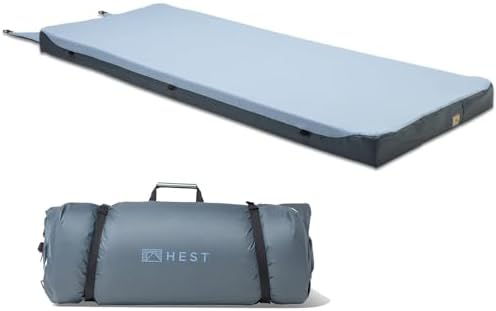
| HEST Foamy (Regular) | Dual-Layer Temperature-Resilient Memory Foam | 3.9 Inches | 11.0 lbs | 8.8 R-Value | 25″ x 12″ (Rolled Cylinder) |
Premium dual-density foam core avoids cold-weather freezing flaws completely. The 25-inch narrow layout fits cleanly down one side of the 60/40 seat split, leaving half the cargo floor open for heavy gear. | Check Price |
| Exped MegaMat Duo 10 | Self-Inflating Open-Cell Foam Hybrid (Medium) | 4.0 Inches | 7.28 lbs (7 lbs 4.5 oz) |
8.1 (ASTM) | 22.0″ x 11.0″ (Packed Tube) |
Official 72″ x 41.0″ blueprint drops flat; pliable open-cell edges easily compress past protruding tailgate hinges and roll-cage tabs cleanly without puncturing. Outstanding thermal insulation. | Check Price |
*Note: Home consumer tri-fold foam beds do not undergo standardized outdoor lab rating certifications under the ASTM F3340-18 layout. Uninsulated polyfoam variants provide a realistic estimated seasonal thermal resistance capacity equivalent of R-1.5 to R-2.2 under mobile vehicle configurations.
Final Verdict: Which Jeep Wrangler Sleep System Wins?
Selecting your ultimate Jeep Wrangler sleep configuration requires balancing your specific chassis format and battery layouts against your daytime transit storage bulk:
- The Absolute Best Overall Performance Setup: For standard 4-door Unlimited overlanding comfort, the Exped MegaMat Duo 10 Medium stands completely unmatched. Its 41.0-inch width drops flat into the cargo pan with zero side bunching, while its hybrid open-cell foam perimeter easily absorbs minor floor crease angles.
- The Premium Solo Overlander Pick: If you run tight mountain trail loops and need half your cargo cabin completely open for heavy refrigerators and power stations, deploy the HEST Foamy (Regular). Its high-density, cold-resilient memory foam core bypasses sub-zero cellular crystallization entirely.
- The Best High-Volume Budget Alternative: If you want a static, solid block setup that natively spans the unlevel mid-row height drop without building a heavy wooden platform deck, utilizing the ultra-thick ROXGOX Twin Trifold offers an exceptionally plush sleeping surface at an affordable cost.
Frequently Asked Questions (FAQ)
Can you fit a standard camping mattress inside a Jeep Wrangler 4xe hybrid?
The Wrangler 4xe features a unique under-seat high-voltage hybrid battery that causes the second-row seats to tumble forward rather than folding flat, shortening the usable trunk bed floor length down to just 56 inches. Standard 72-inch mattresses will not fit unless you build a raised custom platform to level out the 7-inch battery hump.
How do you prevent water from dripping from the hardtop roof while sleeping inside a Wrangler?
“Hardtop rain” is caused by warm breath vapor condensing on the uninsulated fiberglass ceiling panels overnight. Campers prevent this by keeping the rear windows cracked 2 inches with mesh screens, ensuring the vehicle climate system is set to fresh outside air intake (never recirculate), or installing custom insulation panel kits.
Can an adult sleep flat inside a 2-door Jeep Wrangler cabin?
Yes, but it requires maximizing your layout angles. Because the straight linear length is too short, the absolute maximum corner-to-corner diagonal distance across a 2-door Wrangler cabin is exactly 72 inches. Adults up to 5’9″ can sleep flat by building a small supportive table into the rear footwell void and angling a custom-cut foam pad diagonally across the cargo bay.

Written by Enzo S.
Enzo is an outdoor enthusiast with over 12 years of hands-on vehicle overland and car-camping experience. He specializes in testing interior cargo setups, calculating vertical space limitations, and crowdsourcing verified platform build data across active enthusiast networks to provide practical, completely bias-free gear solutions.