Affiliate Disclosure: As an Amazon Associate, I earn from qualifying purchases. If you purchase through our links, we may earn a small commission at no extra cost to you.
This fitment dossier was built by crowdsourcing real-world setup logs, generation-specific trunk measurements, and interior layout debates from dedicated Subaru owner forums and wilderness trail networks. Turning the back of an Outback into a comfortable basecamp sounds simple until you actually try to sleep in it. Standard off-the-shelf camping gear rarely accounts for this wagon’s specific cabin dimensions.
If you throw a generic mattress into the trunk, you are highly likely to wake up sliding backward into the tailgate latch, losing body heat to uninsulated floorboards, or cramped against the plastic wheel wells.
Finding the best car camping mattress for a Subaru Outback is a matter of vehicle spatial geometry rather than a search for the softest foam padding. To establish a flat, comfortable sleeping horizon that avoids morning neck strain, you must design your platform around specific vehicle boundary lines, generational model shifts, and real-world cabin logistics.
Subaru Outback Mattress Fitment at a Glance


The 43-Inch Hard Boundary: Why Queen Mattresses Fail
The narrowest section of the modern Subaru Outback cargo floor measures approximately 42 to 43 inches wide depending on your cargo liner between the rear wheel wells. Because a standard household full mattress is 54 inches wide and a queen is 60 inches wide, forcing a traditional bed into the trunk is physically impossible without the edges buckling violently upward against the plastic trim.
This bunching heavily restricts your shoulder room and places immense friction on the air seams, which frequently leads to overnight deflation.
- The Open-Cell Hybrid Standard: Trail tests and community consensus across enthusiast networks heavily favor self-inflating open-cell foam systems like the Exped MegaMat Duo 10 Medium.
- The Medium Metric Fit: At exactly 41.0 inches (104cm) wide, the Medium variant drops completely flat between the 43-inch wheel wells without folding.
- The Hinge Cushion Advantage: Its internal dense foam provides structural stability that bridges vehicle gaps while acting as a vital cushion over the uneven rear seat hinges.
- The Sizing Warning Note: Note: Make sure to avoid the “Long Wide” (LW) version of the Duo, which spans 52 inches wide and will buckle violently against the interior plastic paneling.
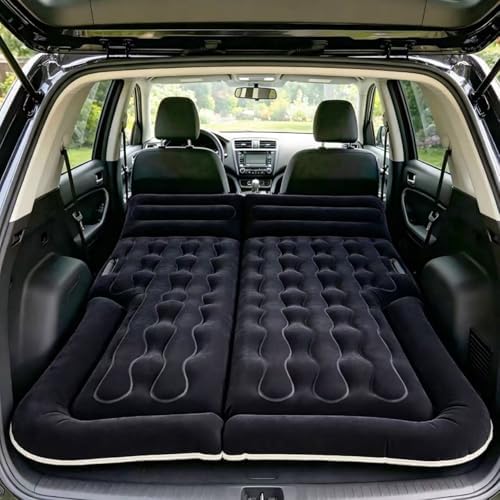
- The Multi-Zone Inflatable Solution: If space-saving in transit is your primary concern, overlander observations suggest using multi-zone inflatable mattresses like the Eooqi SUV Air Mattress.
- The Independent Chambers: These models feature independent air chambers.
- The Arch Contouring Strategy: Inflating the central zone fully while leaving the outer side wings partially deflated allows the mattress to mold perfectly around the wheel arches rather than creasing.
- Center-Console Pressure Points: When choosing an extra-wide or full-width sleep system, pay attention to the rear-facing center console.
- The Console Obstruction Trap: Campers note that rectangular mattresses jam directly into the sharp plastic console trim when front seats are pushed back.
- The Centered Buckling Threat: This causes the mattress to buckle upward in the center and can puncture thin fabrics.
- The Targeted Cushioning Fix: Opt for mattresses with a tapered head-end, or cushion the console corners with a towel.
The 5-Degree Rear Seat Incline: Overcoming the Sleep Slope
A persistent design characteristic across Gen 5 and Gen 6 Outback models is that the folded rear seatbacks do not rest completely flush with the trunk floor. Instead, they leave a permanent 5-degree upward slope tilting toward the front seats.
Backyard tests show that this minor angle is just enough to cause sleeping bags to slide down toward the rear hatch overnight, resulting in bunched bedding, cold feet, and lower back pain by morning.
- The 2×6 Lumber Parking Hack: To counteract this slope without constructing a heavy, permanent wooden sleeping platform, experienced campers leverage basic physics. By parking the rear tires directly onto scrap pieces of 2×6 lumber or standard RV leveling blocks, you lift the rear suspension just enough to level out the interior sleeping horizon.
- Safety & Orientation Rule: If you utilize this leveling method, ensure the vehicle’s electronic parking brake is fully engaged and wheel chocks are placed under the front tires to prevent rolling. Always position your pillows at the front-seat end of the cargo area. If the vehicle is slightly off-level, sleeping “head-up” prevents morning neck strain.
Generational Headroom Limitations: The Thickness Math
The year of your Outback drastically alters your available vertical headroom and total cargo capacity. Failing to execute the exact math on mattress thickness vs. roofline clearance will result in a sleep setup that leaves you feeling highly claustrophobic.
- Gen 5 & Gen 6 (2015 to 2025 models): These model years feature a sloping, traditional wagon roofline.
- The Baseline Roof Height: Vertical headroom from the folded seatback to the headliner hovers tightly at 31.5 inches.
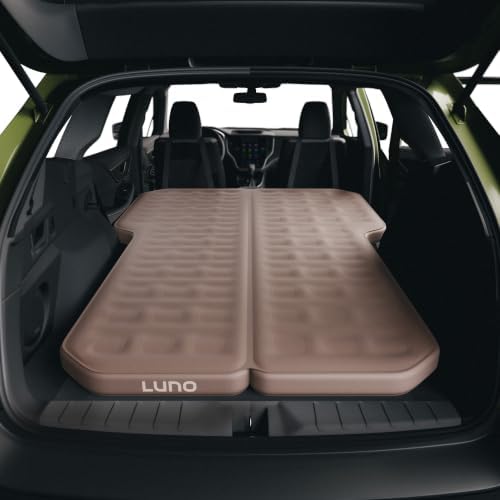
- The Clearance Deduction: If you deploy a premium self-inflating mattress like the 3.93-inch thick Exped MegaMat or the 3.5-inch thick Luno AIR BASE, it leaves you with roughly 27.5 to 28.0 inches of vertical headroom clearance.
- The Sleep-Only Limitation: This mathematical deduction means sitting fully upright inside the cabin is physically impossible for the average adult. You must design your storage around a sleep-only interior configuration.
- The Seventh-Generation Redesign (2026+ models): The fully redesigned 2026 Subaru Outback marks a massive departure, shifting to a boxier, much taller SUV-like silhouette.
- The Dimension Increases: The 2026 model gains over an inch of physical height and features a squared-off rear liftgate.
- The Expanded Capacity Volume: This architectural shift expands total cargo volume to 80.5 cubic feet, which is up from 75.6 cubic feet in older models.
- The New Sleep Advantage: If you own a 2026 or newer model, the squarer cargo bay and vertical headroom expansion deliver unique comfort options.
- Thicker Profile Deployments: The open clearance properties mean you can comfortably deploy thicker mattress models.
- The Spatial Clear Advantage: This updated framework space ensures you stay comfortable without sacrificing essential interior breathing space or feeling trapped against the headliner.
Thermal Realities: Dealing with the R-Value Deficiency
The Outback’s rear load floor sits directly above a large, uninsulated sheet of steel shielding the spare tire well. During cold-weather excursions, this metal draws warmth directly out of the vehicle interior via thermal bridging. Popular custom-fit vinyl air mattresses are highly convenient but vary wildly in insulation value.
- The Insulated Stacking Method: Campers operating in climates below 10°C (50°F) report experiencing severe cold transfer when sleeping on pure air bladders.
- The Thermal Drop Reality: Your body heat rapidly cools the air trapped inside the uninsulated mattress.
- The Supplemental Barrier Fix: To safely bypass this flaw, community field tests recommend stacking a closed-cell foam pad or a heavy wool packing blanket directly beneath your air mattress.
- The Isolation Outcome: This defensive multi-layer core insertion breaks the structural thermal bridge cleanly.
- The Hybrid Alternative: For true winter camping, upgrading your primary platform setup to a foam and air hybrid mat completely transforms your cold-weather defense.
- The High-Efficiency Rating: Investing in a specialized open-cell hybrid layout provides a robust certified R-value of 8.1 or higher.
- The Isolation Boundary: This deep baseline completely blocks freezing cargo floorboard temperatures without requiring supplemental foam base padding layers.
Bridging the 12-Inch Front Seat “Headrest Void”
Sliding the driver and passenger seats fully forward unlocks up to 75.9 inches of total usable sleeping length behind the first row, but it exposes a massive 10-to-12-inch empty gap between the front seats and the folded rear seatbacks. Without a structural bridge, the head-end of your mattress or your pillows will collapse directly down into the rear passenger footwells.
- Inflatable Base Extenders: Specialty setups solve this by utilizing dedicated inflatable cube inserts, like Luno Base Extenders, which rest on the floorboards and support the mattress over the gap.
- The Plywood Bridge Trick: For a low-tech DIY approach, forum builders place a simple 28″ x 38″ sheet of plywood over the void, resting the edges securely on the folded seatbacks. Stiff storage totes packed tightly into the rear footwells achieve the same flush, level support structure before laying down your mattress pad.
Ventilation, Condensation, and Moisture Management
Sleeping inside a completely sealed Subaru cabin causes human respiration to saturate the confined air volume rapidly. On cool mornings, this results in heavy interior window frost or excessive condensation dripping down the plastic side panels onto your bedding fabric.
- The Mesh Window Sock Solution: Community trail tests emphasize that you must never sleep with the windows fully rolled up. Install breathable, slip-over mesh window screen socks or rigid plastic rain guards on the rear doors. This allows you to crack the glass 2 to 3 inches for continuous cross-ventilation while keeping mosquitoes and rain out.
- The Morning Wipe-Down Protocol: To prevent mold, mildew, and dampness from permanently nesting in your vehicle’s fabric roof lining, keep a dedicated microfiber towel handy. Always wipe down the interior glass completely every morning before deflating your mattress or packing your sleeping bags back into your storage totes.
Power Logistics and Battery Management
Inflating high-volume mattresses or running electronic accessories can quickly strand you in the backcountry if you challenge your car’s electrical limits.
- Preventing 12V Battery Drain: High-output 12V electric air pumps draw significant amperage. Community members recommend starting your vehicle’s engine and letting it idle while inflating your mattress to keep the alternator powering the system, preventing the stock starter battery from dropping below critical voltage.
- Cable and Cord Routing: If you are running power cords from portable power stations or the car’s rear 12V accessory sockets to charge devices or run ventilation fans, ensure wires are routed cleanly along the floor trim. Avoid pinching heavy gauge wires in the shifting seat hinges, door jambs, or the automated power tailgate latches, which can easily sever insulation and cause short circuits.
Quick-Reference Gear Comparison Matrix
| Product Name | Mattress Type / Material | Thickness & Width | Insulation (R-Value) | Amazon Action |
|---|---|---|---|---|
| Exped MegaMat Duo Medium | Foam/Air Hybrid 50D Tricot Polyester |
4.0 Inches Thick 41.0″ Width |
8.1 (All-Season) | Check Price on Amazon |
| Luno AIR BASE (Outback) | Chambered Air 200D Oxford Fabric |
3.5 Inches Thick Custom Vehicle Fit |
1.0 (Two-Season) | Check Price on Amazon |
| Eooqi SUV Air Mattress | Multi-Zone Air Flocked Top / PVC |
5.5 Inches Thick 48.4″ Width (Adjustable Wings) |
Near-Zero (Summer Only) | Check Price on Amazon |
| Therm-a-Rest Z Lite | Closed-Cell Foam Molded Polyethylene |
0.75 Inches Thick 20.0″ Width |
1.7 (Supplemental) | Check Price on Amazon |
Final Verdict: Which Outback Sleep System Wins?
Selecting your ultimate Subaru Outback mattress boils down to matching your primary camping season with your available vehicle trunk space. After compiling all the overlander trial logs and physical cabin dimensions, we recommend pinning your sleep layout to one of four definitive paths:
- The Absolute Best Overall Performance Setup: For true four-season comfort, deep cold-floor insulation, and edge-to-edge support over flat folded seats, nothing beats the Exped MegaMat Duo Medium. It fits flawlessly within the 43-inch wheel-well boundary lines without buckling or folding, while its dense open-cell core smoothly cushions the wagon’s 5-degree seat incline.
- The Best Space-Saving Premium Setup: If you are camping exclusively during mild three-season windows and need to minimize transit cargo volume, opting for a custom-fit inflatable system like the heavy-duty Luno AIR BASE Mattress ensures your sleeping system collapses down out of sight and leaves your trunk completely free when it’s time to hit the highway.
- The Best Multi-Zone Budget Alternative: If you need a highly adaptable, affordable air bed that handles variable packing arrangements, the Eooqi SUV Air Mattress serves as an excellent option. Its independent inflation chambers allow you to adjust the outer side wings on the fly to mold perfectly around the Outback’s protruding plastic arches.
- The Ultimate Supplemental Foundation: If you already own an uninsulated air bladder or want to protect your primary mattress setup from raw vehicle condensation and thermal bridging, do not leave home without the Therm-a-Rest Z Lite Original Pad. Placed directly on the cold spare tire sheet metal, it functions as an indestructible reflective thermal shield that safely boosts your sleep warmth.

Written by Enzo S.
Enzo is an outdoor enthusiast with over 12 years of hands-on vehicle overland and car-camping experience. He specializes in testing interior cargo setups, calculating vertical space limitations, and crowdsourcing verified platform build data across active enthusiast networks to provide practical, completely bias-free gear solutions.