Affiliate Disclosure: As an Amazon Associate, I earn from qualifying purchases. If you purchase through our links, we may earn a small commission at no extra cost to you.
Are Car Window Screens Legal? The Quick Answer
Car window screens are completely legal to use when parked for camping, but driving with aftermarket mesh, socks, or fabric screens over your front driver or passenger windows is illegal. Traffic laws classify any front-row material as a view obstruction. However, keeping mesh screens on your rear side windows while driving is perfectly legal in most areas, provided your left and right exterior side mirrors stay 100% clear.
Car window screens are completely legal to use when a vehicle is parked for camping, but installing aftermarket mesh, socks, or fabric screens over front-row driver or passenger side windows while the vehicle is in motion is universally illegal under vehicle safety codes.
Across municipal, state, and provincial jurisdictions, traffic enforcement is triggered by the legal definitions governing “obstruction of the driver’s view.” Any material that restricts visibility through the front windshield or front side glass invites an immediate moving violation citation.
To maintain physical comfort, environmental ventilation, and full legal compliance on the road, overlanders and stealth car campers must separate parked ventilation setups from active driving configurations.
Below is the comprehensive, numbers-driven engineering blueprint and legal baseline distilled from real-world trail tests, legislative statutes, and active enforcement records.
Is It Legal to Drive with Car Window Screens?
When builders research if car window screens are legal, they frequently encounter a common misconception circulating in vehicle-camping forums: that fine-mesh netting or “see-through” synthetic bug socks are permissible while driving because they allow partial visibility.
Overlander trail tests and real-world police interactions heavily challenge this myth. Fines are not handed out based on the porous nature of the material, but rather on whether an aftermarket object limits the operator’s line of sight.
California Window Obstruction Laws Explained
- Statutory Restrictions: Statutes such as California Vehicle Code § 26708 strictly prohibit driving a motor vehicle with any object or material placed, displayed, installed, affixed, or applied upon the windshield or side windows that obstructs or reduces the driver’s clear view.
- Real-World Enforcement: Law enforcement reporting confirms that visibility rules are unyielding. For example, the Calgary Police Service actively tickets motorists for running front-window obstructions, confirming that any physical material limiting visibility through front side glass requires immediate roadside removal and carries active moving infraction fines.
- The Cognitive Blind Spot: From an optical engineering standpoint, looking through porous fabric layers creates a complex moiré pattern that degrades spatial awareness, slows down driver reaction times, and significantly reduces low-light contrast during vehicle operation. Even high-transmittance mesh interferes with side-mirror glare acquisition and peripheral target tracking.
Legal Front-Window Compliance Workarounds
- The Ceramic Tint Loophole: For legal glare and thermal management on the road, experienced builders bypass mesh entirely and install 70% to 75% ceramic window film on the front side glass. Under California window tint regulations, clear or colorless material is permitted if the window glazing combined with the material meets Federal Motor Vehicle Safety Standard (FMVSS) No. 205, maintaining a minimum visible light transmittance (VLT) of 70%. High-grade ceramic coatings reject infrared heat waves at the glass boundary layer without creating a physical line-of-sight obstruction.
- Mandatory Quick-Release Hardware: If builders deploy front mesh screens during brief off-road staging periods or temporary stops, forum consensus dictates using removable magnet-mounted screens rather than slip-over sleeves. This allows the user to instantly pull down the screens before shifting into drive and entering a public right-of-way.
Car Camping Airflow Laws: Parked vs. Driving Rules
The absolute dividing line for vehicle ventilation legality is the physical state of the vehicle. Opaque windshield panels, reflective sunshades, and full-coverage mesh door socks are entirely legal to deploy when your SUV, van, or crossover is stationary, parked on legal campsites, or sitting on private property.
The Operational Trade-Offs of Stealth Camping
While the legal status changes the millisecond a vehicle hits public blacktop, active forum logs on communities like r/urbancarliving detail a dangerous trend known as the “Quick Drive” delusion. A vocal minority of stealth campers admit to leaving fabric window socks on while driving low speeds to quickly relocate between sleeping spots safely hidden from view.
Veteran car dwellers routinely warn against this practice. Traffic officers do not evaluate vehicle speed when issuing visibility citations; they prioritize the immediate physical obstruction, making active mesh a magnet for unwanted police encounters.
Stealth Ventilation and Visibility Failures
- The Occupancy Signal: Pulling a visible mesh sock or cloth screen over a front door frame acts as a massive visual signal to public safety officers, declaring human occupancy inside.
- The “Factory Tint” Alternate: To minimize police knocks while maintaining structural privacy, experienced stealth campers rely on dark, factory-style window tint matching local VLT limits on the rear glass.
- The Clear-Front Strategy: The most effective stealth configuration is to leave front driver and passenger glass completely uncovered, using a dark fabric curtain line pinned directly behind the front headrests. This leaves the vehicle looking completely vacant from the outside while allowing hidden passive ventilation behind the B-pillar.
Rear Window Ventilation Regulations: B-Pillar Legal Rules
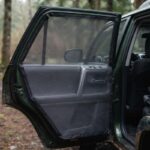
For true mobile airflow compliance, vehicle outfitting must focus entirely behind the B-pillar. Mesh screens installed across rear side doors and the back hatchback glass are generally legal to maintain while driving across the vast majority of jurisdictions, provided one vital constraint is met: the driver’s side-view mirrors must remain 100% unobstructed.
Understanding the Side Mirror Legal Standard
Automotive safety regulations across state and provincial codes—including Title 75 Section 4524 of the Pennsylvania Vehicle Code—recognize that rear-side and back hatchback windows have zero structural transmittance requirements for multi-purpose passenger vehicles, trucks, and SUVs.
Shading or screening these rear zones is completely permissible if the vehicle is equipped with dual, matching exterior side-view mirrors that provide an uninterrupted view of the highway along both sides of the chassis.
Custom Rear Window Mesh Assemblies
- Molded Rain Deflectors (Visors): To crack windows open an inch for passive cross-ventilation without exposing fabric mesh to the outside element layers, experienced builders install rigid acrylic rain guards. This allows airflow to circulate while keeping the screen profile invisible to passersby.
- The DIY “Pillowcase” Mesh Sock: For rapid deployment on rear doors during trail hops, builders stitch fine polyester mesh into a dual-layer slip-over sleeve. By opening the door frame, sliding the sleeve over the top door stamping, and shutting the door on the fabric border, the weatherstripping pinches the net securely into place.
- Loose Rare-Earth Magnetic Framing: On steel-framed doors, using loose N52 neodymium block magnets folded directly inside a double-thick mesh hem bypasses the adhesive delamination failure of standard sticky tapes, creating a durable, zero-residue, high-vibration seal.
Top Car Window Screens & DIY Materials
To build a durable, compliant cabin setup, material selection determines both your airflow volume and overland security. The following products are currently available on and match the precise technical specs required to construct a legal, high-performance vehicle layout.
Skeeta Mosquito Netting Fabric
- Material Base: 40-Denier Military-Grade 100% Polyester Knit
- Application Profile: Custom-cut raw mesh sheets for high-volume stationary bug protection.
- Campsite Utility: Provides an ultra-fine mesh density optimized for micro-insect exclusion (like noseeums) while maximizing passive cross-ventilation.
AplysiaTech N52 Neodymium Block Magnets
- Material Base: Raw Rare-Earth Neodymium (0.5″ x 0.5″ x 0.125″)
- Application Profile: Heavy-duty, quick-release mounting anchors for exterior window screening.
- Campsite Utility: Stitched directly into a double-thick screen hem border to deliver permanent, vibration-resistant clamping force without suffering from high-heat adhesive breakdown.
Frost King Structural Vinyl Gutter Guard Roll
- Material Base: 6-Inch x 20-Foot Rigid Polymer Mesh Matrix
- Application Profile: Budget-friendly, scratch-free structural rear window vents.
- Campsite Utility: Easily trims down to slide directly into active vertical window tracks, serving as an animal-resistant security barrier for under $15.
Luno Large Car Window Screens (2-Pack)
- Material Base: High-Stretch Elastic 70D Nylon Sleeve with Sewn-in Lower Magnets
- Application Profile: Universal slip-over rear door mesh socks.
- Campsite Utility: Slides seamlessly over the upper door stampings of full-sized platforms (such as the Toyota 4Runner, Ford Explorer, and Subaru Ascent) for rapid dry-weather perimeter shielding.
Recommended Hardware Setup & Parts List
| System Component | Target Material Spec | Application Profile & Legality | Recommended Link |
|---|---|---|---|
| Mosquito Screen Mesh | 40-Denier Military-Grade Polyester | Stationary Use Only: Custom cut for magnetic exterior framing screens on steel doors. Banned on front row while driving. | Skeeta Fabric |
| Magnetic Anchors | N52 Neodymium raw block structure | Quick-Release Fastener: Allows instant removal of mesh screens before operating the vehicle on public highways. | AplysiaTech Blocks |
| DIY Window Security | Rigid structural vinyl mesh profile | Rear Window Only: Slips directly into active glass tracks behind the B-pillar. Provides rigid security and animal exclusion. | Frost King Roll |
| Premium Rear Sleeves | Elastic 70D Nylon Mesh with bottom magnets | Standard Framed Doors: Fits full-sized overlanding platforms like the Toyota 4Runner. Note: Will not seat on frameless-glass doors. | Luno Screens |
The Bottom Line: Structuring a Fully Compliant Overlanding Rig
Achieving the perfect balance between overnight campsite cross-ventilation and bulletproof road compliance comes down to intelligent hardware segregation. By focusing your primary mesh and vinyl gutter guard assets completely on the rear side windows and the back hatchback glass, you naturally operate within the dual side-mirror legal allowances of modern highway transit regulations.
Keep your front-row glass completely unobstructed, deploy rapid quick-release magnetic screen borders exclusively during stationary camp windows, and you can keep your vehicle fully optimized for the open trail ahead.
Frequently Asked Questions (FAQ)
Can you drive with mesh bug screens on your car windows?
No, you cannot legally drive on public roads with mesh bug screens installed on your front-row driver or passenger side windows. Law enforcement agencies classify any aftermarket material placed over the front side glass as an illegal line-of-sight obstruction, regardless of how fine or porous the netting fabric is woven. Mesh screens are strictly permitted only behind the B-pillar on rear side passenger doors or the back hatch glass, provided your vehicle’s dual exterior side mirrors remain completely unobstructed.
Are magnetic window screens legal in California?
Magnetic window screens are fully legal to use in California when the vehicle is stationary, parked on public or private land, or deployed at a campsite. However, under California Vehicle Code § 26708, operating a motor vehicle on a public highway with magnetic screens affixed to the front row windows is illegal. The law bans any material that reduces the driver’s clear view, making quick-release magnetic borders an essential engineering choice so they can be instantly yanked down before driving.
How do you get airflow when sleeping in an SUV?
To establish a continuous, passive airflow loop while sleeping in an SUV, you must set up an active convective circuit behind the front-row seats. This is achieved by installing rigid vinyl mesh or magnetic 40-denier polyester screens over the rear passenger windows and cracking the glass down 2 to 3 inches. For optimal performance, pair these rear side window boundaries with an open sunroof or popped rear hatch glass to create a “chimney effect,” allowing superheated metabolic moisture to rise and vent out of the roofline while pulling cool ambient air inward through the rear doors.
Sources & Community References
- Justia Legal Publishing Portal – California Vehicle Code Section 26708: Unlawful Window Obstructions and Material Placements.
- The Pennsylvania General Assembly Vehicle Statutes – Title 75 PA Consolidated Statutes Section 4524: Windshield Obstructions, Sun Screening, and Mirror Requirements.
- r/urbancarliving – Comprehensive Archival Threads regarding Stealth Camouflage Layouts and Front-Row Obstruction Risks.
- r/carcamping – Long-Term Mobile Cross-Ventilation Operational Trail Logs and Police Presence Diagnostic Surveys.
- Expedition Portal Forum – Custom Magnetic Rear Hatch Screen Technical Assembly Sequences and Hardware Blueprints.

Written by Enzo S.
Enzo is an outdoor enthusiast with over 12 years of hands-on vehicle overland and car-camping experience. He specializes in testing interior cargo setups, calculating vertical space limitations, and crowdsourcing verified platform build data across active enthusiast networks to provide practical, completely bias-free gear solutions.