Affiliate Disclosure: As an Amazon Associate, I earn from qualifying purchases. If you purchase through our links, we may earn a small commission at no extra cost to you.
This fitment dossier was built by crowdsourcing real-world setup logs, generation-specific trunk measurements, and interior layout debates from dedicated Honda owner forums and wilderness trail networks.
Finding the camping mattress for your Honda CR-V that delivers flat-floor comfort requires navigating a compact but highly irregular cabin footprint, including a multi-tiered floor drop, specific seat-folding angles, and tight wheel-well clearances.
Optimizing the maximum available cargo length behind the front row is an exercise in vehicle-specific geometry rather than a search for a generic off-the-shelf sleeping pad. To build a safe, comfortable platform, you must design your sleep layout around fixed wheel-well boundaries, generational floor anomalies, and real-world cabin logistics.
Technical Fitment Matrix: Top Honda CR-V Mattress Configurations


The Multi-Tier Floor Drop: Overcoming the CR-V’s Split Level
The primary layout constraint inside a modern Honda CR-V is the pronounced split-level floor drop created when folding down the second-row seats. Community field logs on crvownersclub.com highlight that the rear passenger seatbacks fold forward but do not rest flush with the trunk floorboards.
They create a permanent 4-to-6-inch vertical ledge combined with a permanent upward incline tilting toward the front of the cabin. This drastic unlevel ridge creates a localized pressure point that completely ruins spinal alignment for side and back sleepers.
However, your solution to this split-level obstacle depends entirely on your specific model year and powertrain configuration:
- 5th-Gen Gas Models (2017–2022): Check your trunk floorboard first before purchasing aftermarket modification gear. In standard internal combustion engine (ICE) trims, you can slide the factory carpet deck into the upper-tier built-in side slots. This raises the floor to sit flush with the folded seatbacks, eliminating the floor drop entirely.
- 6th-Gen & All Hybrid Models (2023–Present): The cargo floor is permanently fixed in the low position due to chassis structural changes and hybrid battery placement. You cannot adjust the factory deck panel, meaning you must use the foam board leveling method to flatten the plane.
- The Floorboard Leveling Panel Fix: For fixed-floor owners, laying down a dense layer of rigid insulation foam boards (such as extruded polystyrene sheets cut to size) inside the lower trunk pan builds up a flush baseline to match the seat drop.
- The Sloped Incline Parking Hack: Experienced trail campers leverage gravity to minimize the remaining 12-degree seat slant. Parking the vehicle’s rear tires directly on RV leveling blocks or a natural slight downhill grade counteracts the internal seat slope, normalizing the interior sleeping horizon cleanly.
Custom Sizing Recipes: Managing Tight Cabin Length and Width Limits
Finding the correct mattress means managing a strict length limit of 72 to 74 inches from the rear hatch door to the back of the front row seats, alongside a tight 41.0-inch width choke point between the rear plastic wheel-well trim housing covers.
Because standard domestic Full mattresses (54 inches wide) and Queen mattresses (60 inches wide) drastically exceed this horizontal boundary, forcing them into the cabin causes the edges to buckle violently upward against the plastic trim, pinching available shoulder room and placing immense structural stress on fabric seams.
Furthermore, a 75-inch long mattress will tightly pinch against the front center console unless the front row is pushed completely forward against the dashboard.
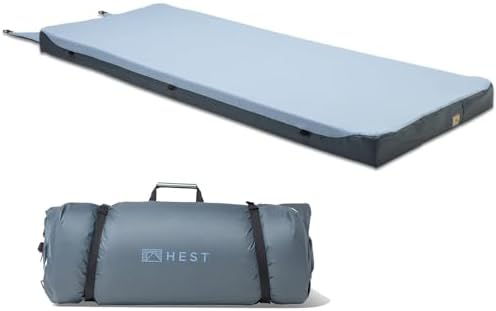
- The Single-Camper Offset Reality: Utilizing a single 25-inch mattress (like the HEST Foamy Regular) centered or pushed to one side in a fixed-floor CR-V will accentuate the 5-inch split-level drop if the floor underneath isn’t pre-leveled. Because rolling memory foam mats cannot be propped up unevenly without twisting and damaging the internal cell matrices, a perfectly flat sub-floor foundation must be established first.
- The Layered Foam Formula Build: For sleepers looking for long-term orthopedic joint support, community tracking threads on The Mattress Underground highlight a dual-density custom foam recipe. Overlanders combine a 4-inch high-density polyfoam support base to prevent bottoming out over floor ridges with a plush 2-inch adaptive memory foam topper layer for deep pressure point relief.
- The Convoluted Topper Air Link: Trail builders recommend utilizing a convoluted (peaked egg-crate) polyfoam core layer. These physical foam channels establish a natural internal ventilation link that promotes continuous passive airflow under the mattress body, completely preventing body heat from trapping moisture against the cold metal trunk panels.
Power Logistics: Avoiding Hatch-Open 12V Battery Drain
Car camping out of a CR-V typically involves leaving the large rear power liftgate wide open for hours at a time during day-camp setups or evening staging. However, community feedback highlights a hidden parasitic power drain issue that can leave solo travelers stranded in the backcountry with a dead starter battery.
- The Power Gate Display Trap: When the liftgate latch stays uncoupled, the vehicle’s ECU remains awake. This keeps a constant “hatch open” warning indicator illuminated across the central dashboard instrument panel cluster. On specific modern CR-V configurations, this continuous module communication loop can drain the compact 12V auxiliary starting battery down below its critical cranking threshold in less than 24 to 48 hours.
- The Physical Bulb Extraction Method: While the main cabin overhead lights auto-extinguish after a set window on modern model years, campers manually flip the cargo trunk light switch completely to the “Off” position. For extra security, removing the trunk cargo light bulb prevents accidental touch ignition and heat accumulation.
- The Latch Loop Bypass Hack: To trick the vehicle into a sleeping low-power state, overlanders use a carabiner or a metal tool shaft to manually push the internal lock mechanism inside the open hatch door catch upward until it clicks twice into its “Locked” position. This turns off the dashboard notification lamp.
- Crucial Safety Rule: Before using the electric close button or latching the tailgate shut, you must pull the interior rear gate handle or trigger the fob to reopen the latch jaws.
- Preventing Damage: This critical step clears the lock mechanism, preventing severe mechanical hinge or latch damage from slamming the gate against a pre-locked catch.
The Emergency Jump Starter Backup Rule: Because modern crossover electronic control units are deeply sensitive to minor system voltage drops, never venture out without an insulated lithium-ion portable jump starter pack stored inside your glove box. This ensures you can instantly jump-start the vehicle from inside the cabin without needing a secondary rescue rig.
Condensation, Cross-Ventilation, and Bug Management
Sleeping inside a tightly sealed CR-V cabin causes human respiration to quickly saturate the interior air volume with moisture. On cool mornings, this results in heavy window frost or water droplets dripping down into your bedding fabrics.
- The Mesh Window Sock Solution: Community trail tests emphasize that you must never sleep with the windows fully rolled up. Install breathable, slip-over mesh window screen socks or rigid plastic rain guards on the rear doors. This allows you to crack the glass 2 to 3 inches for continuous cross-ventilation while keeping mosquitoes and rain out.
- The Morning Wipe-Down Protocol: To prevent mold, mildew, and dampness from permanently nesting in your vehicle’s fabric roof lining, keep a dedicated microfiber towel handy. Always wipe down the interior glass completely every morning before deflating your mattress or packing your gear.
Technical Fitment Matrix: Top Honda CR-V Mattress Options
To guarantee a perfect fit, you must design your sleep layout around the CR-V’s tight 41.0-inch inner wheel-well boundary clearance. This chart tracks the best space-optimized options currently available on Amazon:
| Product Model | Architecture Type | Thickness | Weight | R-Value | Packed Size | Key Pros & Cons | Amazon Link |
|---|---|---|---|---|---|---|---|
| ROXGOX Twin Trifold | 2-Layer Gel Memory Foam & HD Base Blend | 6.0 Inches | ~21.5 lbs | Est. ~1.5 – 2.2* | 38″ x 25″ x 18″ (Folded Cube) |
Pro: Thick 6-inch high-density core cleanly bridges the multi-tier cargo floor drop levels. Con: Massive folding cube reduces available cargo transit storage space; polyfoam core adds notable bulk. |
Check Price |
| HEST Foamy (Regular) | Dual-Layer Temperature-Resilient Memory Foam | 3.9 Inches | 11.0 lbs | 8.8 R-Value | 25″ x 12″ (Rolled Cylinder) |
Pro: Specialized foam architecture avoids sub-zero temperature lock; dirt-proof outdoor utility shell. Con: Single sleep system bounds; higher financial profile investment tier. |
Check Price |
| Exped MegaMat Duo 10 | Self-Inflating Open-Cell Foam Hybrid (Medium) | 4.0 Inches | 7.28 lbs (7 lbs 4.4 oz) |
8.1 (ASTM) | 22.0″ x 11.0″ (Packed Tube) |
Pro: Official 72″ x 41.0″ blueprint drops flat between 41.0-inch rear wheel arches, compressing easily with zero bunching. Con: Demands active physical body weight compression during deflation phase. |
Check Price |
*Note: Home consumer tri-fold foam beds do not undergo standardized outdoor lab rating certifications under the ASTM F3340-18 layout. Uninsulated polyfoam variants provide a realistic estimated seasonal thermal resistance capacity equivalent of R-1.5 to R-2.2 under mobile vehicle configurations.
Final Verdict: Which Honda CR-V Sleep System Wins?
Selecting your ultimate Honda CR-V mattress comes down to balancing raw platform thickness against your day-transit storage tolerance. Based on real-world overlander trial logs and interior constraint tracking, we recommend pinning your build setup to one of three clear paths:
- The Absolute Best Overall Performance Setup: For true four-season comfort, cold floor insulation, and edge-to-edge support inside tight cabins, nothing beats the Exped MegaMat Duo 10 Medium. Its 41.0-inch width drops flat over the wheel wells without creasing, completely blocking cold air radiating from the uninsulated steel tire pan.
- The Premium Solo Overlander Pick: For solo campers who prioritize quick camp deployments and deep sub-zero insulation, opt for the HEST Foamy (Regular). At 25 inches wide, it rolls up cleanly alongside your secondary gear bins while its specialized 11 lb dual-density polyfoam architecture avoids freezing cell-locking flaws.
- The Best Budget-Friendly Static Option: If you are trying to keep costs low and want a thicker, solid foam structure that bridges the 5-inch split-level floor drop natively without a platform build, deploying the ultra-thick ROXGOX Twin Trifold guarantees a flat operating baseline at a fraction of the cost.
Honda CR-V Car Camping Mattress: Frequently Asked Questions
How do you level the floor in a Honda CR-V for camping?
For 5th-Gen gas models (2017–2022), you can slide the factory carpet deck into the built-in upper side slots to sit flush with the folded seats. For 6th-Gen and Hybrid models (2023–Present), the floor is fixed low due to the battery; you must lay down a dense layer of rigid insulation foam boards (like extruded polystyrene) cut to size to flatten the 4-to-6-inch split-level drop.
Will keeping the Honda CR-V hatch open drain the battery?
Yes. Leaving the rear liftgate open keeps the vehicle’s ECU awake, causing a parasitic 12V battery drain that can strand you in 24 to 48 hours. To fix this, use a carabiner to manually push the internal lock mechanism inside the open hatch door upward until it clicks twice into its Locked position, tricking the vehicle into a low-power sleep state.
What mattress width fits perfectly between the Honda CR-V wheel wells?
The tight inner wheel-well choke point inside the Honda CR-V is exactly 41 inches wide. Standard domestic Full or Queen mattresses will buckle against the plastic trim. A mattress designed to this exact footprint, such as the Exped MegaMat Duo 10 Medium (72 by 41 inches), drops perfectly flat without bunching.
Can you use a regular twin or full mattress in a CR-V?
No. Standard domestic Full mattresses (54 inches wide) and Queen mattresses (60 inches wide) drastically exceed the CR-V’s tight 41-inch inner wheel-well boundary. Forcing them into the cabin causes the edges to buckle violently upward against the plastic trim, pinching available shoulder room and placing immense structural stress on fabric seams.
How long of a mattress can fit in the back of a Honda CR-V?
The standard flat cargo length inside the CR-V from the rear hatch door to the back of the folded second row is roughly 58 to 64 inches. While sliding the front seats completely forward against the dashboard extends the available length to 73 or 74 inches, a 75-inch or longer mattress (like the 78-inch HEST Foamy Regular) will drastically overshoot the cabin space. It will jam tightly against the front center console, preventing the rear hatch from closing. For a seamless fit in the CR-V, stick to shorter mattress profiles like the 72-inch Exped MegaMat Duo M.
.

Written by Enzo S.
Enzo is an outdoor enthusiast with over 12 years of hands-on vehicle overland and car-camping experience. He specializes in testing interior cargo setups, calculating vertical space limitations, and crowdsourcing verified platform build data across active enthusiast networks to provide practical, completely bias-free gear solutions.